
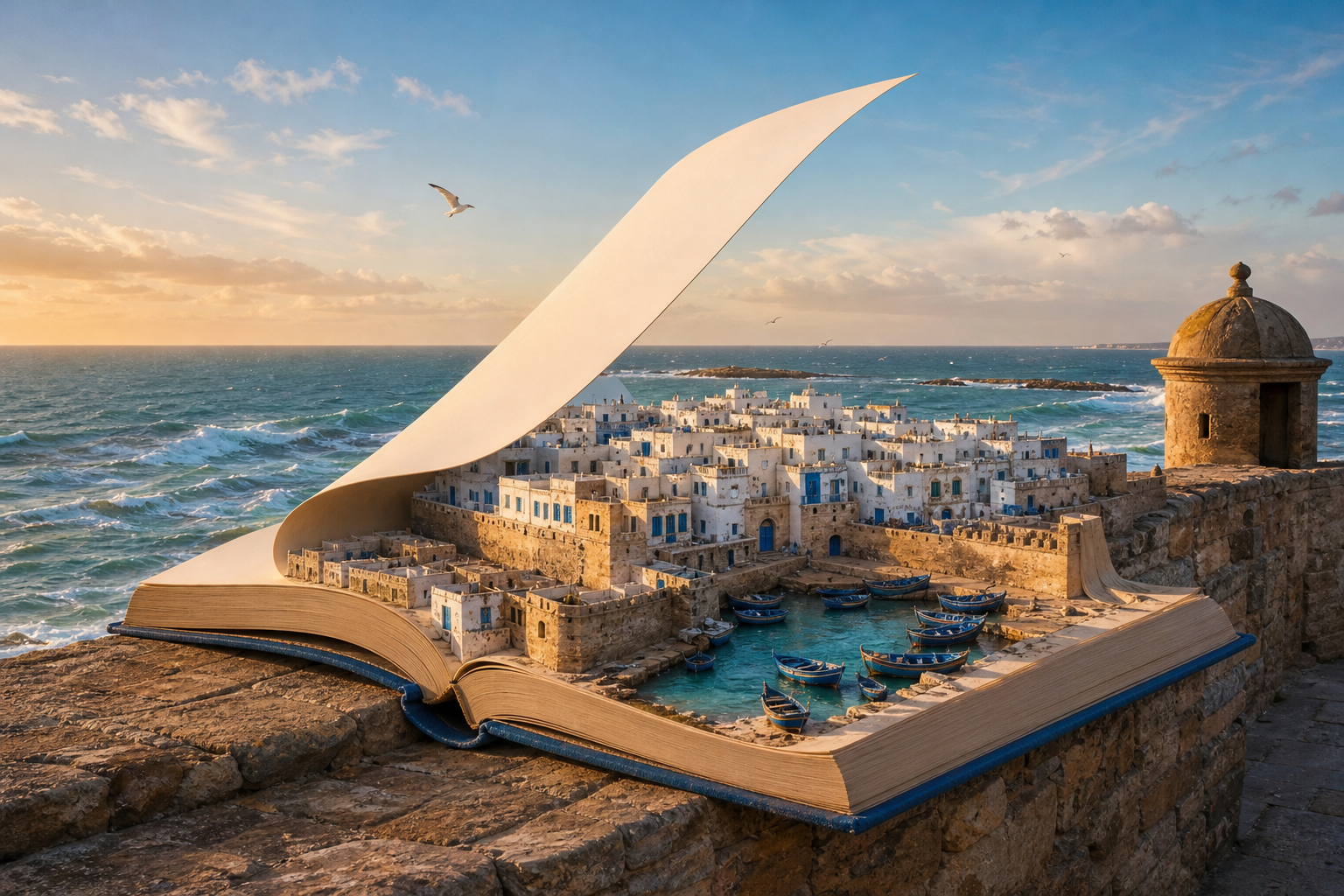
Most people arrive in Essaouira as a day trip from Marrakech — three hours each way in a shared taxi or bus, two hours wandering the medina, a tagine somewhere near the port, then back. It’s not a bad day. But it completely misses what the place is actually good for, which is a kind of slow, wind-battered coastal rhythm that Marrakech specifically doesn’t have.
View larger map | Map data © OpenStreetMap contributors
Essaouira sits on the Atlantic, not the Mediterranean, and that distinction matters more than it sounds. The Alizé trade winds blow in hard off the water for most of the year — reliably enough that the town has become a serious windsurfing and kitesurfing destination, and aggressively enough that you’ll spend your first afternoon holding your hat and reconsidering your opinion of wind. By the second day you’re used to it. By the third you might find the stillness of inland Morocco slightly suffocating by comparison.
The Medina Is Small — Use That
The UNESCO-listed medina here is genuinely compact compared to Fès or Marrakech. You can walk the full perimeter of the ramparts in under an hour. That’s not a limitation — it means you can actually learn the layout rather than perpetually being lost, which changes the experience entirely. The main tourist drag, Avenue Mohammed Zerktouni running into Avenue de l’Istiqlal, takes about ten minutes end to end. Don’t stay on it.
The working harbor on the southern side is where fishing boats still come in every morning and the fresh catch gets sold directly off the boats or in the stalls immediately behind. The seagull situation is extreme. The sardines are cheap and genuinely good when grilled to order at the harbor-adjacent stalls — this is not a sophisticated dining experience, it’s a plastic-stool-and-newspaper-tablecloth situation, and it’s correct.
The ramparts themselves — the Skala de la Ville on the ocean-facing north side and the Skala du Port near the harbor — are worth the time specifically at late afternoon, not midday. The northern sea bastion still has original Portuguese cannons lined up along the wall, pointing out over water that feels like it goes uninterrupted to Brazil. The light at that hour does something genuinely dramatic to the white-and-blue walls of the medina below.
What the Town Actually Produces
Essaouira has a specific craft tradition around thuya wood — a dense, aromatic root burl from the Atlas cypress that grows in the region. The woodworking workshops in the medina are real working studios, not showrooms, and the grain in finished thuya pieces is distinctive enough that you can tell genuine work from tourist-grade imports. Go into the workshops rather than just buying from the stalls outside them. Prices are negotiable everywhere, but the quality range is wide enough to matter.
The town also has a small but active visual arts scene, partly a legacy of its 1960s and 70s reputation as a bohemian refuge. Jimi Hendrix is invoked constantly in tourist marketing, and yes, he visited briefly in 1969, but that connection has been stretched well past its actual significance. Skip the café named after him and the tour that ends at the “castle he supposedly stayed in.” The real arts presence is in the galleries around Rue Laalouj and in the Galerie Damgaard, which has been showing local Gnawa-influenced painters since the 1980s — that’s the actual cultural thread worth following.
Practical Notes That Actually Matter
The wind is genuinely cold between November and March, even when the sun is out. Essaouira sits at roughly 31°N latitude, which sounds warm on paper, but the Atlantic and the Alizé make it feel nothing like Marrakech in winter. Pack a layer you’d be comfortable wearing in a stiff coastal wind, not just a medina-hopping layer.
Getting here from Marrakech: the CTM bus takes around three hours and costs very little — book at the CTM station rather than through third parties. Shared grands taxis from Bab Doukkala in Marrakech are faster but require either filling the taxi yourself or waiting for other passengers. If you’re coming from Agadir to the south, the drive north along the coast road is one of the better coastal drives in Morocco — argan trees the whole way, plus roadside cooperatives selling argan oil. If you’re buying: smell it first. Real argan oil for cooking is nutty and slightly savory; anything that smells neutral has likely been cut or processed down.
Accommodation inside the medina varies dramatically in quality. The riads here are smaller and cheaper than Marrakech equivalents, which is good, but the building stock is older and the salt-air environment is hard on anything not properly maintained. Read recent reviews specifically for damp and noise rather than relying on photos. The northern part of the medina, close to the sea bastion, puts you nearer the wind — whether that’s a feature or a problem depends entirely on how you sleep.
The Gnawa Festival Question
Essaouira hosts the Gnawa and World Music Festival every June — four days of open-air concerts centered on Gnawa music, a trance-based tradition rooted in sub-Saharan African spiritual practice that arrived in Morocco through the slave trade and has been evolving here for centuries. It’s legitimately worth attending. It’s also genuinely packed, with tens of thousands of visitors descending on a medina that holds a few thousand residents. Accommodation books out months ahead. The music starts late and runs until 3am or beyond.
If you’re sensitive to crowds, June festival week is the wrong time to discover Essaouira. The town is better understood at rest. Outside festival week you get the music culture in smaller, quieter doses — Gnawa musicians perform in the medina year-round, often in the evenings near the main square, and lila ceremonies (private trance rituals) happen throughout the year rather than just in June.
Two nights is the honest minimum for this to be worth the travel time from Marrakech. One night means you arrive, sleep, and leave before the place has actually opened up. Three nights makes sense if you want to get out of the medina and spend time on the beach north of town, which is long, mostly empty outside summer, and carries the Atlantic surf that kite schools operate on. It is not a swimming beach — the currents are serious and the water is cold year-round.
If your Morocco itinerary currently has Essaouira as a day trip from Marrakech, make it a proper stop and cut something else. The thing you cut will probably be a second night somewhere you’d already seen enough of.