
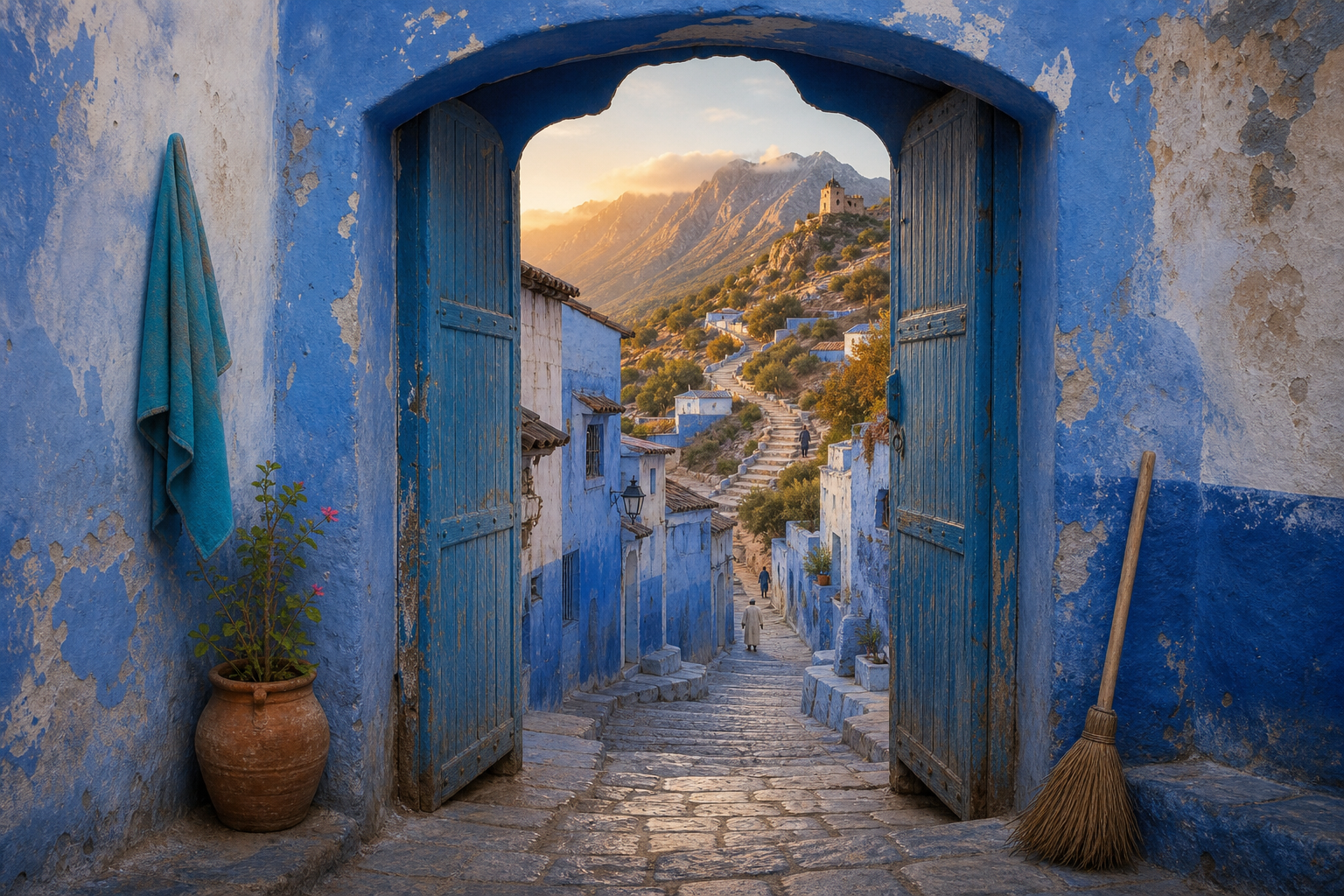
Most people give Chefchaouen a night, take a few hundred photos of blue alleyways, and leave. That’s not a criticism — the town is genuinely photogenic in a way that invites exactly that kind of hit-and-run visit. But it also means the majority of tourists are seeing the same three streets in the medina, shooting from the same angles, and missing the actual reason the place is worth a slower stay.
View larger map | Map data © OpenStreetMap contributors
Why Two Nights Is the Minimum That Makes Sense
The math on a single-night stay is punishing. Chefchaouen sits in the Rif Mountains, about 110km from Tétouan and nearly 4 hours by bus from Fès depending on which service you catch. Arrive in the afternoon and leave the next morning, and you spend the warmest, harshest-light part of the day doing most of your walking — then leave before the town shows any other face. Two nights gets you the early morning and the early evening, which are genuinely different experiences than midday.
The blue isn’t constant. It reads blue-grey before 7am, bright and saturated by mid-morning, then flat and overexposed through the midday hours. Late afternoon going into sunset hits a particular depth that’s hard to describe without sounding like a brochure, so I’ll just say: that’s the time to be in the upper medina, not at a café with a view.
The Medina Itself — What’s Actually Worth the Walk
Plaza Uta el-Hammam is unavoidable and fine — there’s a 15th-century kasbah on one side, the Grand Mosque on the other, and café tables full of tourists by 9am. Worth walking through, not worth anchoring your time around.
The medina’s upper sections, past the obvious tourist-facing shops, are where the residential character of the place starts to show. Streets narrow. Doors are genuinely used rather than decorative. The blue paint gets less curated — patchy in places, fading in others — and that’s actually more interesting than the freshly-painted sections near the square. Follow Rue Targhi or the streets running roughly northeast from the kasbah and tourist foot traffic drops to almost nothing within about ten minutes of walking.
The souk is small compared to Fès or Marrakech, which is the point. It functions. Locals buy things here. The textile section has wool blankets and djellabas at prices that aren’t opening positions in a negotiation — they’re closer to what things actually cost. Give it a proper hour rather than a through-glance.
Outside the Medina: The Hike to Talassemtane
This is the part most one-night visitors never get to, and it’s the best reason to build in a third day if you can manage it.
Talassemtane National Park starts effectively at the edge of town. The most-walked trail climbs to the Spanish Mosque — a ruined 1920s-era mosque on a ridge above Chefchaouen that takes about 40 minutes from the medina at a reasonable pace. The views over the town from there are better than any rooftop terrace, and early morning you’ll often have the hill to yourself. The mosque is a hulking concrete skeleton, structurally unimpressive but oddly compelling as a ruin.
Beyond that, longer routes run into the cedar forest and down toward the Ain Tissimane gorge. These require more planning: good shoes, water, and ideally a local guide if you’re going deep rather than sticking to the main trail. The national park administration office in town can advise on current conditions. Don’t rely on cached maps for anything off the main trail — the terrain is more complex than it looks at the trailhead.
Getting There: Buses vs. Grand Taxis
CTM runs the main intercity bus routes. Fès to Chefchaouen takes roughly 4 hours, Tétouan is around 2 hours, and Tangier is about 3 hours on a good day — longer if the Rif Mountain roads have traffic or the bus stops more than expected. Book CTM tickets ahead if you’re traveling on a weekend or during summer; the Fès route fills up.
Grand taxis from Tétouan are faster and roughly comparable in cost if you’re sharing. They leave when full — typically 6 passengers — so the wait can vary. If you’re flexible on departure time and coming from the north, grand taxis are usually worth it for the time saved.
Driving yourself works if you’re already renting a car in Morocco, but parking inside or immediately adjacent to the medina is genuinely difficult. Ask your guesthouse where to leave a car before you arrive, not while you’re circling looking for a spot.
Where to Stay: The Medina vs. Outskirts Trade-Off
Staying inside the medina is louder — the calls to prayer echo considerably in enclosed streets, and some smaller guesthouses have thin walls. It’s also more atmospheric, and means you’re out in the alleyways within thirty seconds of leaving your door, which matters if you’re planning early-morning walks. Staying outside the medina means quieter nights and usually larger rooms, but you’re a 10-15 minute walk from the interesting parts of town every single time.
If you’re staying two nights, spend at least one inside the medina. Riad-style guesthouses on the upper north end tend to be quieter than the ones immediately around the main square. Read recent reviews specifically for noise — it varies a lot by exact location and isn’t something price tier predicts reliably.
Food: Lower Expectations Appropriately
Chefchaouen is not a culinary destination. The food is decent — tagines, harira, kefta, the usual Moroccan standards — but nothing here is going to match what you’d eat in Fès or Marrakech at an equivalent price point. The restaurants around Plaza Uta el-Hammam are calibrated for tourist volume, not quality.
Better meals tend to come from smaller places one street back from the main square, and from guesthouses that offer breakfast or dinner to guests. Msemen — the layered flatbread — with honey and argan oil at breakfast is genuinely excellent and costs almost nothing at any café that isn’t exclusively tourist-facing.
One caveat worth stating directly: Chefchaouen is historically associated with kif (cannabis), and it’s sold openly in some areas. It remains illegal in Morocco for visitors regardless of what you’re offered or how casually it’s presented. That’s not a moral position, it’s a practical one — enforcement is inconsistent and the consequences for foreigners can be serious.
When to Go
April and October are the most reliable months. Summer (July–August) is hot and at peak tourist density — the medina gets crowded in a way that genuinely changes the experience. Winter brings cold nights and the possibility of rain but also far fewer people, which some travelers find worth the trade. The Rif Mountains can see snow in January and February, which closes some of the hiking options but makes the town look quite different.
Route Chefchaouen between Tangier and Fès, give it two real nights, and do the Spanish Mosque hike your first morning before you’ve done anything else — it’s the single best way to orient yourself to the town’s geography before you lose an afternoon getting happily lost in the medina.