
Kotor’s walled old town is genuinely beautiful and genuinely overrun. In peak summer you’re navigating cruise-ship crowds through streets that are, at their widest, about four meters across. An hour south across the Albanian border, Shkodër has a medieval fortress, a lake, a cycling culture that feels almost Dutch, and a fraction of the footfall. Most visitors to the Adriatic Balkans never consider it. That’s a bad call.
View larger map | Map data © OpenStreetMap contributors
Why Shkodër Gets Skipped
The border crossing reputation puts people off — both Hani i Hotit (overland from Montenegro) and Muriqan (closer to the coast) are functional and usually fast outside July-August peak, but the paperwork anxiety around entering Albania lingers from a decade ago when crossing was genuinely more complicated. It isn’t now. EU, UK, US, and Australian passport holders enter visa-free, and Albanian lek is easy to pull from ATMs in town.
The other reason is that Kotor has a marketing machine behind it: every Balkans itinerary blog lists it, every tour operator routes through it, and Montenegro has done a serious job positioning the Bay of Kotor as a flagship destination. Albania is still catching up, which is exactly why going now beats going in five years.
Rozafa Castle: The Fortress That Earns the Climb
Rozafa sits on a rocky outcrop above the city where three rivers meet — the Drin, the Buna, and the Kiri converge below it in a way that makes the strategic logic immediately obvious. The castle has layers going back to Illyrian times, with serious fortification work added by the Venetians and then the Ottomans, and you can trace the different building phases in the masonry if you look for it.
The views from the upper ramparts over Lake Shkodër and toward Montenegro are the best single panorama on this stretch of the Adriatic hinterland. Go in the morning before it gets hot. The climb takes about twenty minutes from the main gate and is fully unshaded.
The small museum inside covers the local legend of Rozafa — a woman supposedly walled alive into the foundations so the castle would stand — with more care than you’d expect for a site this size. Worth the extra few minutes.
Lake Shkodër and the Cycling
Lake Shkodër (Skadar in Montenegrin, Scutari on older maps) is the largest lake in the Balkans by surface area, shared between Albania and Montenegro. The Albanian side sees far fewer visitors than the Montenegrin national park side, and for cycling it’s genuinely good — flat lakeside roads, minimal traffic away from the main highway, and bike rental near the pedestrian zone runs to a few euros a day.
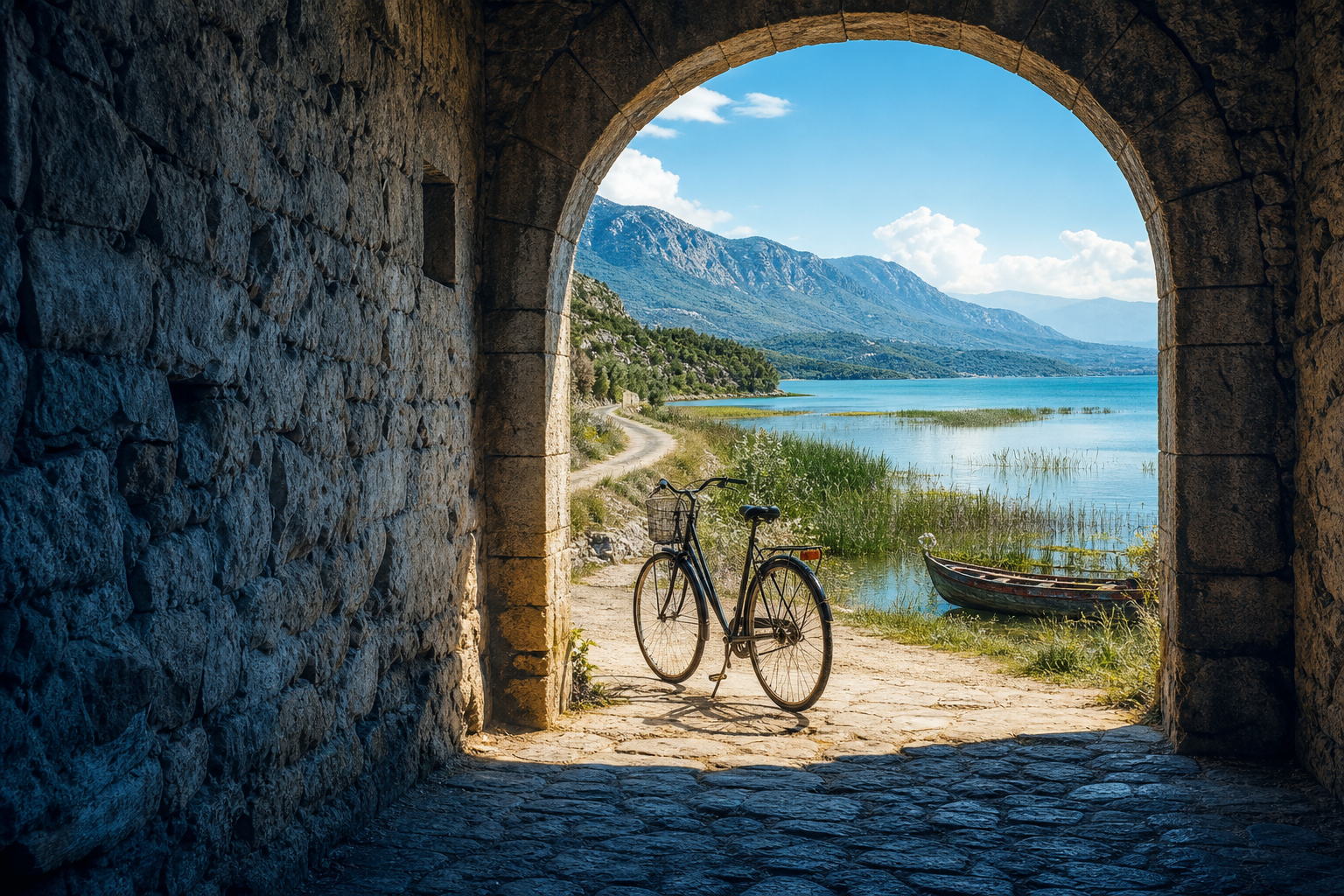
The ride out toward Shiroka takes about 45 minutes each way and passes reed-lined shores where fishermen still use traditional wooden boats. It’s not a dramatic landscape — flat, wide, quiet. That’s precisely why it works as an antidote to three days of jostling through Kotor’s stone corridors.
Small boat trips run from Shiroka out onto the lake, including toward the monastery island of Beška on the Montenegrin side. Local operators sometimes arrange the return without a formal border crossing — confirm this before you commit, because enforcement has varied and it’s not something to assume.
The Pedestrian Zone and Eating
Shkodër’s Rruga Kolë Idromeno is a long pedestrianized street that functions as the social spine of the city. Cafés spill onto it from 7am, the evening xhiro (the Albanian tradition of the promenade) fills it after 6pm, and the architecture mixes Ottoman-era buildings with Italian-influenced facades from the early 20th century.
Food is cheap and worth paying attention to. Tavë kosi — baked lamb with yogurt and egg — is the Albanian dish most worth seeking out; several restaurants near the pedestrian zone do it well for under 800 lek. Fish from the lake, particularly carp, shows up on menus near Shiroka. Byrek from any bakery open in the morning — phyllo stuffed with spinach or cheese — costs almost nothing and is good enough to be annoying about.
Skip the hotel restaurants unless you’re somewhere that has specifically invested in the kitchen. The better eating is in small lokale that don’t have English menus or Instagram presences.
How Long to Stay
Two nights is enough to do the castle properly, get a half-day cycling ride in, and walk the pedestrian zone without rushing. Three nights lets you add a full day trip — either the Theth Valley to the northeast (rough road, absolutely worth it if you have any interest in Albanian Alps scenery) or a slower exploration of the Montenegrin side of the lake.
One night is too short. You’ll arrive, do the castle at dusk, have dinner, and leave before you’ve understood what the city is actually like to be in.
Getting There
From Kotor, the most common route goes via Budva and the Muriqan-Morinë border crossing into Shkodër — 90 minutes to two hours by bus or shared taxi depending on the border wait. Furgons (Albanian shared minibuses) run from the crossing into Shkodër regularly through the day. There’s no direct scheduled bus from Kotor itself, but the connection through Ulcinj, Montenegro’s southernmost town and worth a stop on its own, is straightforward.
From Tirana, Shkodër is two hours north on the SH1 highway, with multiple bus and furgon services running daily from the main bus station area. If you’re building an Albania-first itinerary, this is a much smoother connection than the Montenegrin approach.
One practical note: accommodation options are thinner than you’d expect for a city this size. Book ahead even in shoulder season. The better guesthouses, particularly anything near the old city or with lake views, fill faster than the overall tourist volume would suggest, mostly because the total supply of decent rooms is just small.
Honest Caveats
Shkodër is not a polished destination. Road infrastructure around the lake has improved but is still patchy in places. Signage to historical sites is inconsistent. The castle museum is listed as open 9am-5pm, but arrive by 3pm if you want to be sure you’re getting in.
The city also has a complicated recent history that’s worth knowing something about before you go. Shkodër was among the most heavily persecuted cities during the Hoxha regime’s isolation period (1944-1990). The Franciscan church in the center was converted to a volleyball court during the communist years; it’s been restored, and the history isn’t hidden. Sheshi Demokracisë (Democracy Square) has context about the transition period if you want to spend time with it.
None of this makes Shkodër harder to visit. It makes it more interesting than another Adriatic postcard.
If you’re routing through the Balkans with Kotor already on the itinerary, the question isn’t whether to add Shkodër — it’s whether you’ve built in enough nights to actually be there rather than just passing through it on the way to Tirana.