
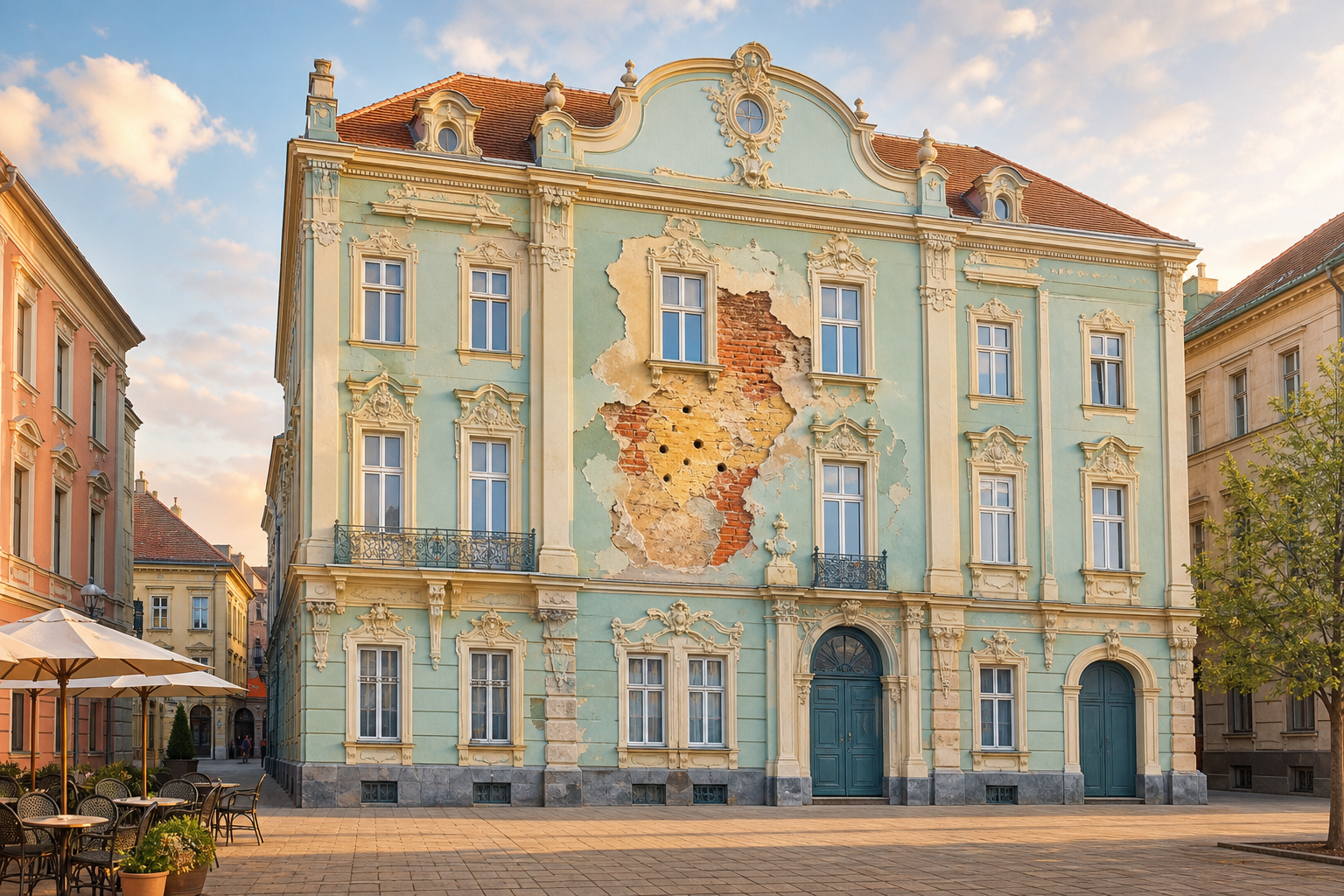
Timișoara held the title of European Capital of Culture in 2023, which generated a lot of press coverage and very little increase in actual tourist traffic. That’s a fairly unusual outcome — Valletta, Matera, and Plovdiv all saw measurable visitor spikes from the same designation — but for Timișoara it mostly meant new murals, some renovated concert venues, and a city that continues to get skipped by Romania itineraries that default straight to Bucharest and Cluj-Napoca.
View larger map | Map data © OpenStreetMap contributors
That’s worth correcting. Timișoara is a genuinely different kind of Romanian city: architecturally Austro-Hungarian rather than communist-bloc, historically significant in ways most visitors don’t know going in, and compact enough that two full days covers it properly without feeling rushed.
What the City Actually Looks Like
Timișoara sits in the Banat region near the Serbian and Hungarian borders, which explains everything about its character. The Habsburgs administered it for nearly two centuries, and the built environment shows it: grand squares, ornate pastel-colored baroque facades, wide pedestrian boulevards. It reads closer to Vienna’s peripheral districts or a larger Novi Sad than anywhere else in Romania.
The three main squares — Piața Victoriei, Piața Unirii, and Piața Libertății — are all within easy walking distance and each has a distinct feel. Piața Unirii is the oldest and most photogenic, ringed by the Catholic and Orthodox cathedrals facing each other across the square. That arrangement isn’t accidental: Timișoara was always ethnically and religiously mixed — Romanian, German, Hungarian, Serbian, and Jewish communities in unusually close proximity — and the architecture still shows the layers.
Piața Victoriei is where people actually spend time, lined with restaurants and cafés under a long colonnade, with the Romanian Orthodox Metropolitan Cathedral at the far end. The cathedral was completed in 1946 and the style is a strange but successful hybrid of Byzantine and Moldavian ecclesiastical architecture. Go inside. The interior is better than the exterior suggests.
The 1989 Connection
Timișoara was where the Romanian Revolution started, in December 1989 — the first city in the Eastern Bloc where protests successfully toppled a communist government, before Bucharest’s own upheaval followed days later. The revolution began here partly around the eviction of a Hungarian Reformed pastor named László Tőkés, and what started as a small crowd defending his home became the first public challenge to Ceaușescu’s regime that held.
This matters for a visitor because it’s genuinely legible in the city. You can walk the route of the protests, see the bullet holes still preserved in building facades near Piața Victoriei (intentionally left unrepaired), and visit the Memorial of the 1989 Revolution, which is small but carefully put together. It’s not a sanitized museum. It includes testimonies, photographs, and artifacts that give a clear-eyed account of what happened, including the disputed casualty figures that Romanian historians still argue over.
Don’t skip it because it’s a museum. It reframes everything else you see in the city.
The Fabric District and What’s Happening There
Beyond the historic squares, the Fabric neighborhood is where Timișoara’s younger, more interesting version of itself is visible. It’s a 19th-century working-class district that came through the communist period largely ungentrified and is now at an early stage of the transition Bucharest’s Floreasca and Cluj’s Mănăștur neighborhoods went through a decade ago — independent coffee shops, small galleries, and restored courtyards alongside buildings that still look genuinely rough.
The Jewish community’s historical presence is concentrated here. There’s a restored synagogue on Strada Mărășești that’s one of the better-preserved Moorish Revival synagogues in Central Europe, though opening hours are limited and it’s worth contacting the local Jewish community in advance if you specifically want to get inside.
Fabric is also where you’ll find Timișoara’s actual food scene rather than the tourist-facing restaurants on Piața Victoriei. The local wine culture draws heavily on the Recaș winery about 20km outside the city — Romania’s largest wine exporter, producing everything from entry-level bottles to genuinely interesting skin-contact whites — and most places in Fabric pour it by the glass at prices that feel absurd compared to what you’d pay in Bucharest.
Day Trips Worth Building Time For
The Banat region has two things most visitors who make it this far completely miss.
The first is Băile Herculane, a spa town about 90km southeast that was once one of the Austro-Hungarian empire’s most fashionable thermal resorts. It’s now severely dilapidated — the grand 19th-century casino and hotel complex is in partial ruin, which makes it more striking in some ways than a restored version would be. The thermal baths still operate in a more functional modern facility nearby. If you have any interest in faded imperial infrastructure or urban decay photography, Băile Herculane is extraordinary and almost entirely empty of tourists.
The second is the Nera Gorges and Beusnița Waterfalls natural park, further southeast, which has turquoise limestone pools that look implausible for Romania and get a fraction of the attention that similar formations in Croatia or Slovenia attract. Getting there requires a car or a guided tour — no useful public transit — but the drive through the Banat hills is part of the point.
Practical Notes
Timișoara has its own international airport with connections to major European hubs including London Luton, Munich, and Amsterdam. Ryanair and Wizz Air both serve it, which keeps fares low. The train from Bucharest takes around seven hours — long enough that flying or taking the overnight train makes more sense if you’re coming from the capital. From Budapest it’s roughly three and a half hours by rail, which is genuinely easy.
Spring (April–May) and early autumn (September–October) are the best windows. July and August get hot: Timișoara sits in a flat basin and summer heat in the Banat is punishing, and the city’s outdoor café culture — which is genuinely central to daily life here — works better when you’re not melting through it.
Accommodation is cheap relative to Western Europe but has fewer boutique options than Cluj-Napoca. The historic center is small enough that staying anywhere near Piața Victoriei puts you within walking distance of essentially everything that matters.
One real caveat: the renovation projects from the 2023 Capital of Culture year were uneven. Some public spaces came out significantly improved; others absorbed investment that a visitor would never notice. Don’t arrive expecting a transformed urban showcase. It’s still a real, somewhat rough-edged Romanian city that happens to have excellent bones — and that’s most of what makes it worth the trip.
The bullet holes in the facades near Piața Victoriei are the detail worth sitting with after you leave. Most cities patch things over. Timișoara decided to keep them visible.