
Vientiane, Laos: The Capital Most Travelers Sprint Through Without Realizing What They’re Missing
View larger map | Map data © OpenStreetMap contributors
Vientiane gets a bad reputation by comparison. It’s not Luang Prabang — it doesn’t have the golden spires stacked against misty mountains and the saffron-robed monks at dawn. It’s not Bangkok. It’s not anything dramatic, which is exactly why most travelers treat it as a one-night layover between the bus from the Thai border and the flight north. That’s a misjudgment.
Give it two full days and something shifts. The city runs at a pace that’s genuinely slower than most Southeast Asian capitals — slower than Phnom Penh, slower than Yangon, slower than Hanoi — not because it’s sleepy, but because the Lao approach to things is just structurally unhurried. You either adapt to it or you don’t, and travelers who don’t are the ones who come back saying there’s nothing to do here.
What’s Actually Worth Your Time
Pha That Luang
The golden stupa on the city’s northeastern edge is on the 1,000-kip note, the national seal, and basically every piece of Lao official iconography. It’s worth visiting for actual historical reasons, not just the imagery. The outer cloister has Buddha images that have been accumulating for centuries, and the central stupa itself — 45 meters, built on the foundations of a Khmer structure from the 3rd century CE — has a visual weight that photos don’t convey. Go in the late afternoon when the gold catches decent light. Weekday mornings are quiet outside of festival periods.
Wat Sisaket
This is the one temple in Vientiane that survived the 1828 Siamese sack of the city intact, which is why it’s both the oldest temple still standing and the most historically meaningful to actually understand. The cloister walls have around 6,000 small Buddha niches cut into them, most still containing figures, many cracked or headless from the destruction that took everything else. The contrast between what survived here and what was lost citywide is a more useful frame for Vientiane’s history than any museum exhibit. It sits directly across from the Presidential Palace, easy to pair with a morning walk.
The COPE Centre
Laos is the most heavily bombed country per capita in history — the U.S. dropped more ordnance on it between 1964 and 1973 than was dropped on all of Europe during WWII, much of it cluster munitions that still kill and injure people today. The COPE Visitor Centre near the National Rehabilitation Hospital documents this clearly and without melodrama. It’s free, it takes about an hour, and it reframes everything else you see in Laos for the rest of the trip. Not comfortable, but it’s one of the better-constructed exhibits of its kind in the region.
The Mekong Riverfront at Dusk
The waterfront promenade runs along the southwestern edge of the city and looks directly across to Thailand — you can see Nong Khai from the Lao bank on a clear day. Every evening a night market sets up along the riverside: food stalls, vendors selling cheap clothing and trinkets, families on plastic chairs eating laap and drinking Beer Lao. Eat here rather than at the restaurants near Nam Phu fountain, which charge significantly more for food that isn’t noticeably better. The riverfront is where Vientiane residents actually spend their evenings, and that distinction is immediately obvious once you’ve sat at both.
Patuxai
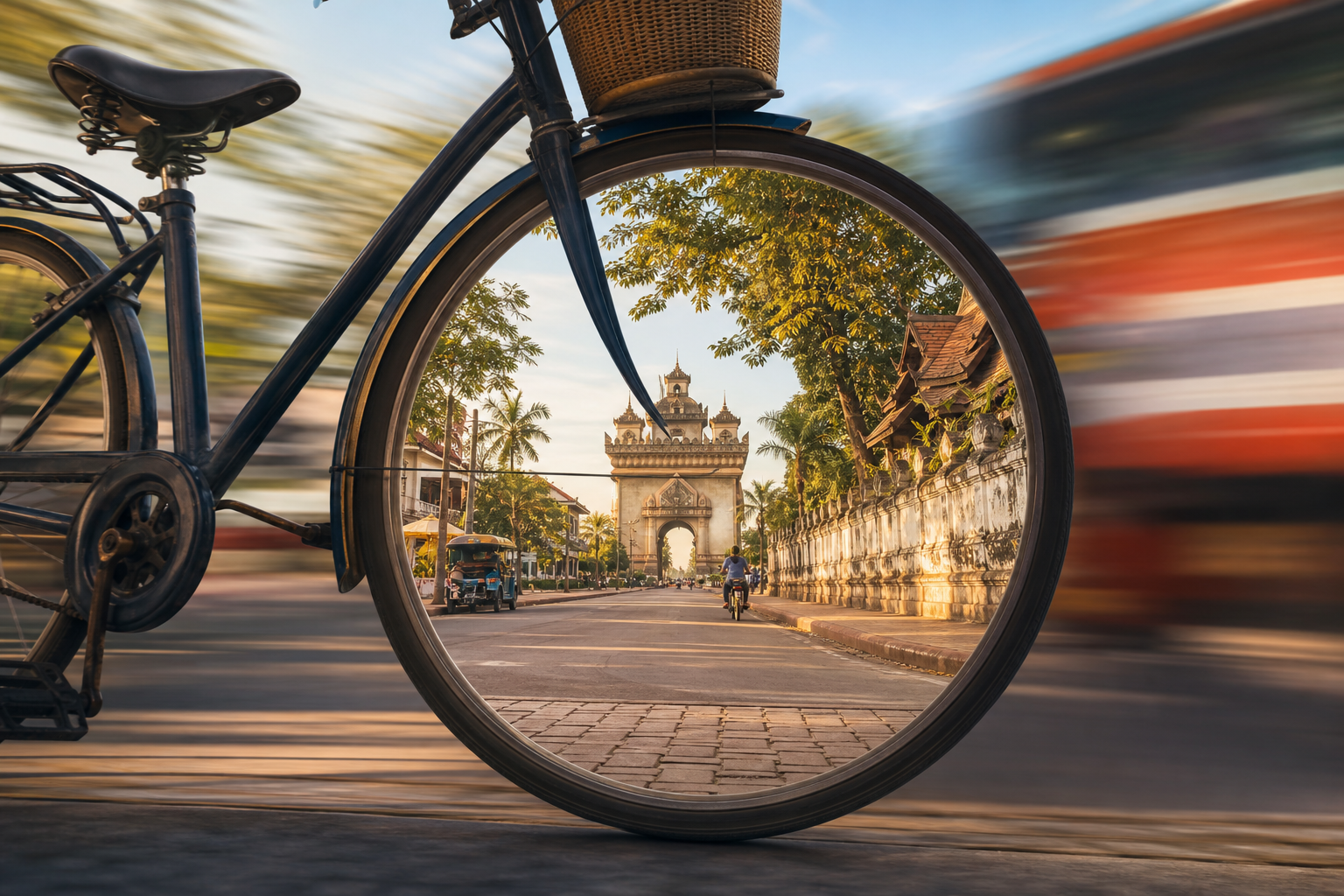
The concrete arch in the middle of the central boulevard was built with U.S.-donated cement intended for a runway extension at Wattay Airport — the Lao government diverted the materials in the 1960s, which is why it gets called the “vertical runway” in local deadpan. Walk up for the view over the city, but the real interest is the ceiling and interior: traditional Lao mythological painting done inside a structure that’s unmistakably modeled on the Arc de Triomphe. The cognitive dissonance is the point.
Eating in Vientiane
Lao food is distinct from Thai in ways that matter. It’s heavier on fermented fish paste (padaek), uses more fresh herbs and bitter greens, and sticky rice is not a side dish — it’s the vehicle for everything else. For breakfast, find khao piak sen (a rice noodle soup, simpler and more gelatinous than Vietnamese pho) at any streetside stall near the morning market. For laap — the minced meat salad that is Laos’s actual national dish — look for places with Lao-language signage and plastic furniture rather than English menus. The price difference is real and the food is better.
The Talat Sao (Morning Market) is worth an early visit despite running most of the day. The building closest to the road sells textiles, silverwork, and traditional Lao silk; the adjacent building is more practical goods. The silk is genuinely good here, and prices are grounded rather than performative — you’re expected to negotiate, but not as theatrically as in Thai tourist markets.
Getting There and Around
Wattay International Airport sits about 4 kilometers from the city center, which keeps taxi fares low by regional standards. Lao Airlines connects to Bangkok, Hanoi, Kuala Lumpur, and several domestic towns; Bangkok Airways and Thai Airways cover the BKK route with more frequency. If you’re already in northeastern Thailand, the Friendship Bridge crossing from Nong Khai is the overland option and noticeably cheaper than flying.
Getting around the city means tuk-tuks and the occasional songthaew — there’s no reliable metered taxi system. Negotiate before you get in and get a reference fare from your guesthouse first. Cycling is genuinely viable: the city is flat, compact, and several guesthouses rent bikes for a dollar or two a day. It’s actually the better way to move between the main sites if the heat is manageable.
When to Go and When Not To
Vientiane in April is brutal. The hottest stretch of the Mekong region’s year coincides with Lao New Year (Bun Pi Mai), which is a significant cultural event but also means water fights city-wide, crowded roads, and many businesses closed for several days. November through February is when the weather makes sense — dry, not oppressively hot, and the evening riverside market is actually comfortable to sit at for more than fifteen minutes.
And yes, Luang Prabang is more beautiful. If you only have one Lao destination, that’s probably the right call. But if you’re routing through on the way north — or south on a Thailand loop — two days here rather than none makes the trip to Laos feel like something other than a border crossing with a flight attached.
Worth asking yourself before you skip it: how many places have you actually been where the capital is the least-visited part of the country?