
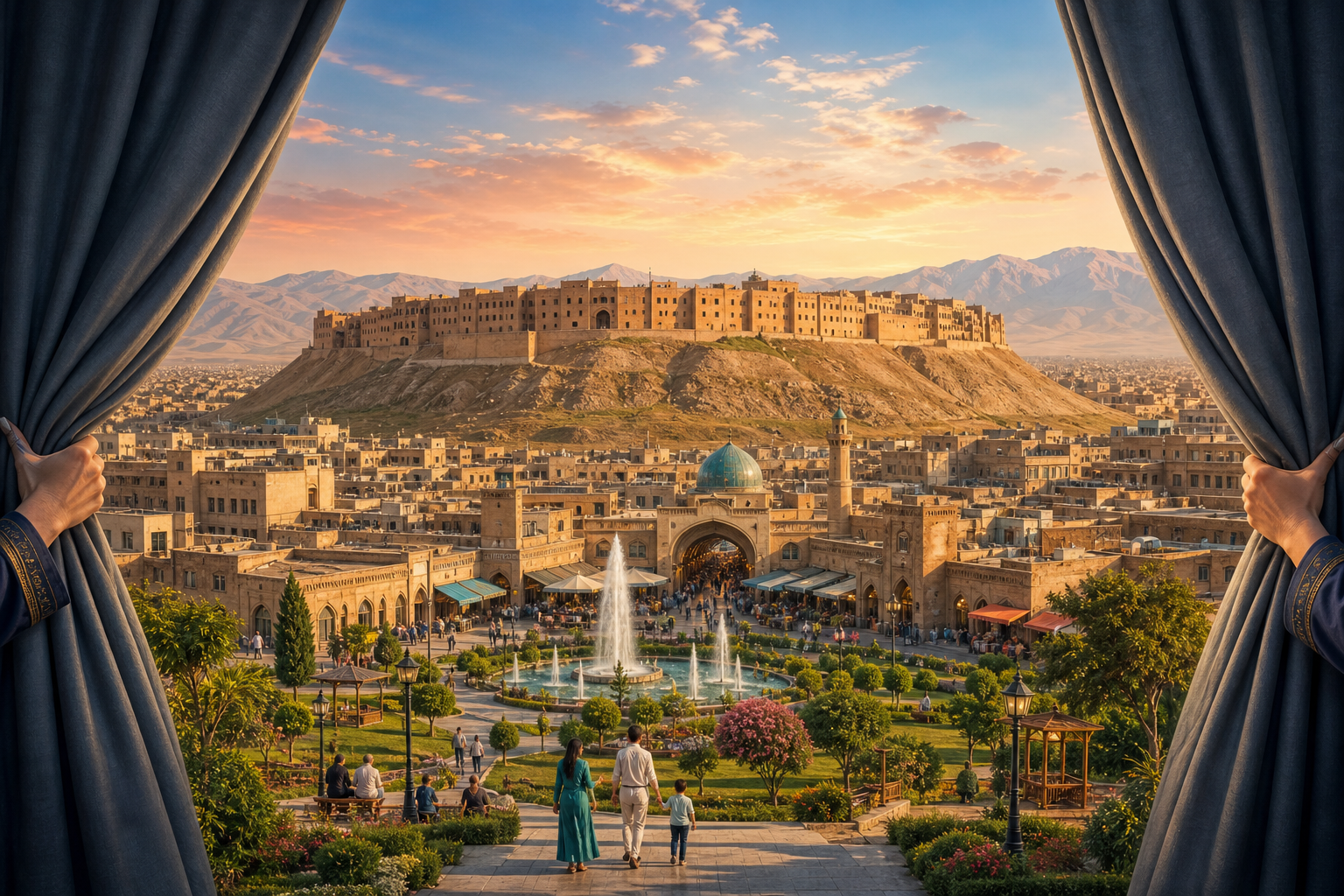
Erbil Doesn’t Get the Attention It Deserves
View larger map | Map data © OpenStreetMap contributors
Most people’s mental map of Iraq doesn’t include tourism. That’s understandable and also increasingly outdated, at least for the Kurdish region in the north. Erbil — or Hawler, as it’s known in Kurdish — has been continuously inhabited for somewhere between 6,000 and 8,000 years. The citadel rising out of the city center sits on an archaeological tell that UNESCO inscribed as a World Heritage Site in 2014. There are places in Europe that get ten times the foot traffic and have a fraction of the history.
Iraqi Kurdistan operates semi-autonomously from the rest of Iraq, with its own immigration controls, its own peshmerga security forces, and a visa-on-arrival system that most passport holders can use independently of whatever visa rules apply to the rest of the country. Flight connections have improved: direct or one-stop routes run from Istanbul, Amman, Dubai, Vienna, and Frankfurt, among others. Getting there is genuinely less complicated than it was five years ago.
The Citadel: Don’t Just Look at It from the Ground
The Erbil Citadel is the dominant visual fact of the city — a massive oval mound rising about 30 meters above the surrounding streets, with a continuous ring of old houses along its edge. You can see it from almost everywhere in the center. Most visitors photograph it from the main square below and move on.
Go up. The citadel interior is partially restored and partially ruined, and the narrow lanes inside are largely empty of the crowds you’d expect at a UNESCO site this old. There’s a textile museum and a weaving workshop toward the eastern side worth the stop, and the views over modern Erbil from the northern edge give you the full sense of how dramatically the mound dominates the city. Restoration work is ongoing, so some sections are closed at any given time — that’s not a reason to skip it. There’s enough accessible to spend two hours up there without doubling back.
The square at the base, Shar Park, is where Erbil locals actually spend evenings — food vendors, families, occasional live music on weekends. After sunset, this is where you want to be, not inside a restaurant near the tourist hotels.
Qaysari Bazaar: More Functional Than Picturesque, and That’s the Point
The covered bazaar at the foot of the citadel is one of the oldest continuously operating markets in the Middle East. It’s divided by trade — copper, textiles, spices — and it reads as a working commercial bazaar rather than a heritage attraction. That’s a compliment. The vendors are not performing for tourists because there aren’t enough tourists to bother performing for.
Prices for textiles, dried fruit, and spices are genuinely good. Saffron from the Kurdish highlands runs a fraction of what you’d pay for Iranian saffron of comparable quality in European cities. The covered sections stay cool even in summer, which matters in a city that regularly hits 42–45°C in July and August.
On timing: summer in Erbil is brutal. Visiting in April, May, October, or November is meaningfully different from visiting in July — not just more comfortable but more functional, since peak-summer heat compresses outdoor activity into early morning and late evening and you end up seeing less overall. March has the added advantage of Newroz (Kurdish New Year) celebrations, which are worth planning around if your schedule allows it.
A Day Trip to Amadiya and the Barzan Valley
The mountain region northeast of Erbil is a different landscape entirely from the city: green valleys, terraced villages, rivers cold enough in spring to be genuinely surprising. Amadiya sits on a flat-topped mountain at around 1,400 meters and has been a defensible settlement since at least the Assyrian period. It’s a small town — a few thousand people — with an old city gate, a minaret, and views over the Amadiya canyon that are hard to overstate.
Getting there from Erbil without a car is possible but awkward; shared taxis run toward Duhok and connections exist, but renting a car or hiring a driver for the day makes more sense if you want to get into the valleys rather than just reach Amadiya town. The drive through the Barzan Valley — the ancestral home of the Barzani family and the Kurdish peshmerga movement — has its own weight if you know even a little of the history.
Leave Erbil by 7am. That gives you enough time in Amadiya before the afternoon heat builds and enough margin for the drive back without rushing the valley sections that are actually the best part.
Lalish: The Yazidi Pilgrimage Site
About 60 kilometers northwest of Erbil, in a narrow valley in the Shekhan district, is Lalish — the holiest site in the Yazidi religion. The Yazidi are one of the world’s most ancient and least understood religious communities, and after the genocide ISIS carried out against them in Sinjar in 2014, the survival of this community and this site carries a weight that isn’t easy to articulate.
Lalish is open to non-Yazidi visitors during daylight hours, and the welcome is genuine. You remove your shoes at the entrance and walk barefoot through the entire sacred complex — conical-roofed shrines, underground tunnels, spring water that flows through the site year-round. A local guide isn’t mandatory but makes the difference between seeing buildings and understanding what they mean. Ask at your accommodation in Erbil for a recommendation rather than booking blind online.
If you’re not prepared to approach it with actual curiosity, skip it. Go with attention and it’s one of the more singular places in the entire Middle East — genuinely unlike anything else in the region.
Practical Notes: Safety, Visa, and Movement
The Kurdistan Region of Iraq is distinct from the security situation in central and southern Iraq. Erbil and Sulaymaniyah have operated as stable, relatively safe cities for years. That said, most Western foreign ministry travel advisories still flag Iraq broadly, and some travel insurance policies won’t cover you anywhere in the country regardless of which region you’re actually in — check your policy before you go, because this is the kind of detail that creates a problem after the fact rather than before it.
The visa on arrival at Erbil International Airport is straightforward for most nationalities; the fee varies by passport. The process takes about fifteen minutes on a quiet day. If you’re entering through Erbil or Sulaymaniyah airports and staying within the Kurdistan Region, you do not need a separate Iraqi visa.
Carry cash. Card acceptance exists in larger hotels and some restaurants, but the economy runs predominantly on cash and ATMs that accept international cards are unreliable outside the major hotels. US dollars are widely accepted alongside the Iraqi dinar.
Where to Stay
The range runs from international business hotels — Rotana and Divan both have properties in Erbil, built for the NGO and corporate travel market that drove the city’s hospitality development — to smaller guesthouses in the older neighborhoods. The business hotels are competent and expensive by regional standards; the guesthouses are cheaper and more interesting. For a first visit, staying within walking distance of the citadel keeps logistics simple and puts you close to the bazaar and Shar Park.
Book ahead in spring, especially around Newroz. Accommodation fills faster than most travelers expect during that period, and prices reflect it.
Erbil pairs naturally with Amman or Istanbul for onward routing if you’re building a broader regional itinerary. A 6,000-year-old citadel, a functioning ancient bazaar, a living pilgrimage site, and mountains within a day’s drive adds up to a genuine argument for three nights rather than a one-night curiosity stop. The consistent pattern among people who go is wishing they’d stayed longer — build that in before you book, not after you arrive.