
Trieste Doesn’t Fit Neatly Into Any Italy Itinerary — That’s the Point
View larger map | Map data © OpenStreetMap contributors
Most people routing through northeastern Italy fly into Venice and either stay there or use it as a one-night launch pad for Slovenia. Trieste, 160 kilometers east down the coast, barely registers. Which is a strange oversight for a city that was, for most of the 19th century, the main port of the Austro-Hungarian Empire — a place that shaped the careers of James Joyce and Italo Svevo, and still operates as Italy’s largest port by cargo volume.
It’s not a hidden gem in the “nobody knows about this” sense. The city just doesn’t slot conveniently into the standard Italy narrative of Renaissance art and cobblestone villages. Trieste is Central European in architecture, Italian in language, and Slovenian in its immediate hinterland. That layering is exactly what makes it worth several days rather than a rushed afternoon.
What the City Center Is Actually Like
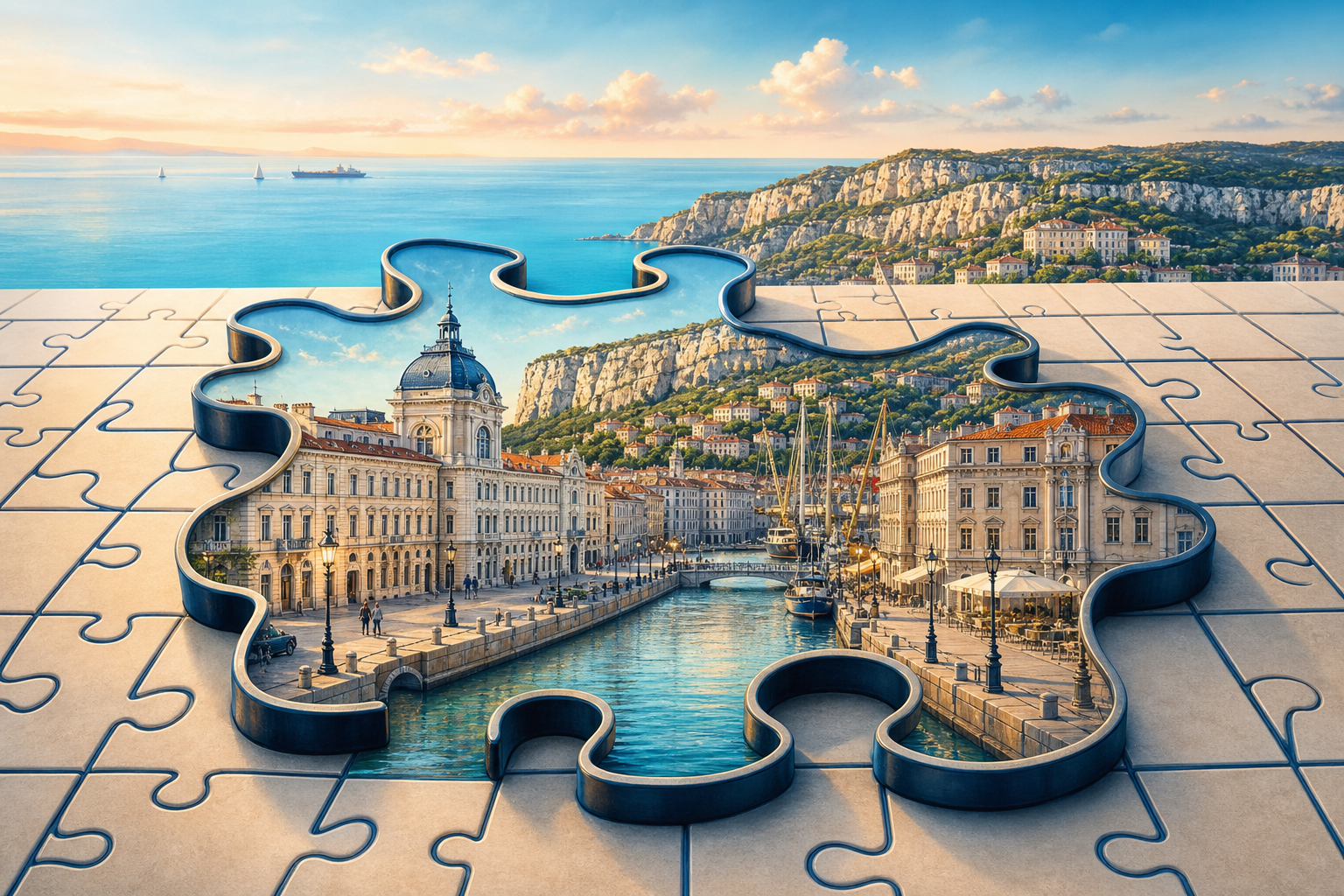
The core of Trieste is the Canal Grande, a short inland canal lined with cafes and the Serbian Orthodox church of Sant’Antonio Nuovo at its head — a building that has no business working architecturally next to the neoclassical surroundings, but does. The Piazza Unità d’Italia faces the sea directly, which is rarer than you’d think for a port city; most European harbor squares turn their backs to the water. Here it’s the main civic space, and it’s large enough that it doesn’t feel cramped even when there’s something on.
The old city climbs steeply behind the canal — the Città Vecchia on the hill — with narrower streets and the ruins of a Roman theater partially excavated into a residential neighborhood in a way that feels genuinely casual rather than heritage-managed. You can look down into it from street level without buying a ticket.
The Castello di Miramare Is Not Optional
Seven kilometers north of the center along the coast, Miramare Castle was built in the 1850s for Archduke Maximilian of Austria before he left to become, briefly and disastrously, Emperor of Mexico. The interior is preserved almost exactly as furnished in the 19th century — not a museum reconstruction, but actual period rooms with original furniture and objects. It doesn’t feel like every other palace tour, which is a low bar that most palace tours still manage to clear in the wrong direction.
The castle sits on a promontory above the Adriatic with a formal park behind it and one of the cleaner unobstructed sea views on the northern Adriatic coast off the terrace. Go on a weekday if possible — weekends in summer bring tour buses from Udine and Venice.
Getting there: the number 6 bus from Piazza Oberdan takes about 25 minutes and runs frequently enough that you don’t need to plan tightly around it.
The Coffee Culture Here Is Specific and Worth Knowing Before You Order
Trieste has its own coffee terminology, and it diverges from the rest of Italy in ways that matter at the counter. Ordering a caffè here gets you a small espresso served in a glass. What the rest of Italy calls a cappuccino is a capo in b (capo in bicchiere). A nero is the local term for a standard espresso.
Order wrong in a traditional Triestine café and you’ll get something you didn’t want — not a disaster, but worth knowing. Illycaffè was founded here in 1933 and is still headquartered in the city, which gives the coffee culture historical grounding rather than just local quirk for its own sake.
The one café worth going out of your way for is Caffè San Marco on Via Cesare Battisti. It opened in 1914, has the original Liberty-style interior intact, functions as a working bookshop as well as a café, and is not a tourist replica of itself — it’s still where people actually sit and read. Joyce wrote parts of Ulysses at a table here. The coffee is genuinely good.
Day Trip Into Slovenia: Lipica and the Karst Plateau
The Slovenian border is 15 minutes from the city center by car. The Karst plateau directly behind Trieste is where the geology term “karst” comes from — the landscape that named the phenomenon is this specific one. The Lipica stud farm, origin of the Lipizzaner horses, is just across the border and open to visitors with scheduled guided tours; check schedules before going because riding demonstrations don’t run every day.
The Škocjan Caves, a UNESCO World Heritage site about 30 kilometers into Slovenia, are the stronger choice over the more famous Postojna further north. The underground canyon at Škocjan is larger, the crowds are smaller, and the walking tour lets you actually engage with the scale of the place rather than rolling past it on a cave train. Neither requires a car — buses and organized day trips run from Trieste’s bus station — but a car makes the day considerably more flexible.
Eating in Trieste Without the Tourist Trap Radius
The food identity reflects the position: Adriatic seafood, Central European influence on meat dishes, Slovenian and Croatian ingredients crossing the border. The dish that makes this geography most legible is jota, a bean and sauerkraut soup with no real Italian equivalent — it makes complete sense once you know where the city sits, and almost none if you’re expecting standard northern Italian food.
The Mercato Coperto on Via Carducci is the main covered market and the most reliable way to calibrate what things actually cost before eating anywhere with a tourist-facing menu. The fish stalls are worth the visit even if you’re not buying.
One thing worth knowing about: the hills outside Trieste have a higher concentration of osmize than anywhere else in the region — traditional farmhouse wine stops where local wine and simple food is served, often open only for short windows and historically marked by a branch of fir hung over the gate. Their schedules are irregular and rarely advertised online. The most reliable approach is to ask at any wine shop in the city whether any are currently open — that consistently works better than searching.
When to Go and How Long to Stay
Three nights is the minimum that makes Trieste worthwhile as a destination rather than a detour. Two nights is doable but you’ll leave feeling like you skimmed it. The city gets busier in July and August but isn’t overwhelmed the way Venice is — the scale is genuinely different. The bora, a cold northeastern wind, is a real weather factor from November through March; gusts can reach 100 km/h and rope handrails are installed along some exposed streets specifically because of it. That’s not a reason to avoid winter — the city is quieter and cheaper — but it does affect how you plan days and what you pack.
Flying in: Trieste Airport (TRS) has limited direct connections from most origins. Venice Marco Polo (VCE) is the more practical arrival point — trains from Venice Santa Lucia to Trieste Centrale take around two hours, run multiple times daily, and cost roughly €12–20 depending on how far ahead you book.
The standard objection to adding Trieste is that it doesn’t fit the itinerary template. That’s worth sitting with, because the template is usually the problem — not the city.