
Tarragona, Spain: The Roman City Most Costa Daurada Trips Drive Past
View larger map | Map data © OpenStreetMap contributors
Tarragona was the Roman Empire’s most important city on the Iberian Peninsula — capital of Hispania Citerior, home to a population of around 30,000 at its peak, and the seat of Augustus himself during the Cantabrian Wars. The amphitheatre sits directly on the sea cliffs. The city walls still carry traffic above 2,000-year-old Roman foundations. And on a reasonable summer Saturday, you can walk the entire archaeological circuit with no queue anywhere.
Most people driving the Costa Daurada between Barcelona and Valencia don’t stop. The ones who do tend to stay one night and leave feeling like they rushed it. Two nights is the right answer, and it’s rarely expensive enough to justify cutting it short.
What the Roman Sites Are Actually Like
The UNESCO designation covers the whole archaeological ensemble — Tarragona is one of twelve UNESCO sites in Spain — but the word “ensemble” is doing a lot of work. These aren’t clustered attractions you can walk between in an hour; they’re scattered across the old town and the surrounding landscape in a way that rewards a full day on its own.
The amphitheatre is the most immediately striking. It’s genuinely one of the better-preserved examples in the western Mediterranean, and its position on the edge of a cliff facing the sea makes the setting absurd in a good way. A Visigoth basilica was later built inside the arena itself, using the existing Roman walls as the shell — so you’re looking at three overlapping layers of history from one spot. Skip the audio guide and just walk it slowly; the site is small enough that you don’t need an interpreter.
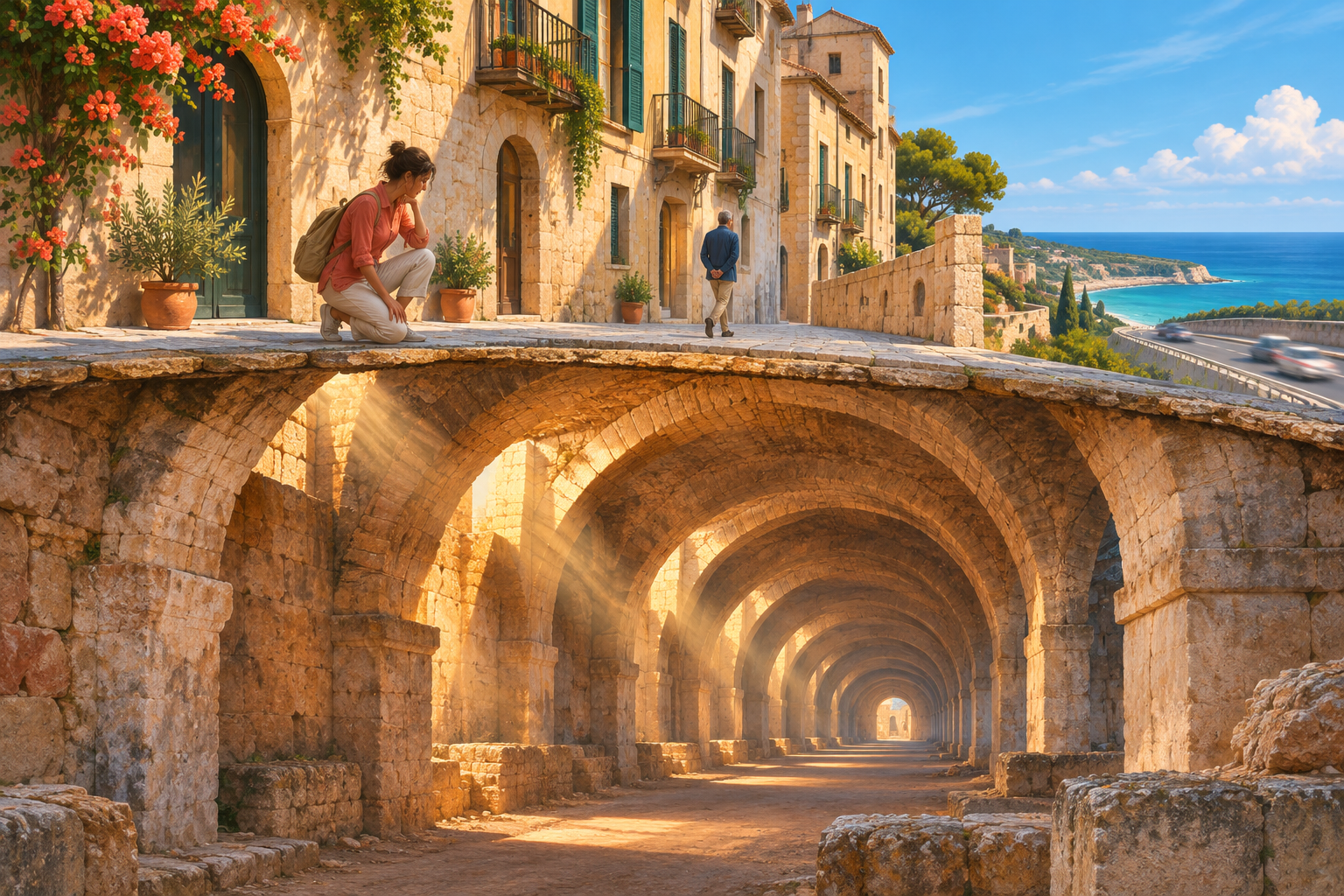
The Roman circus is less obvious. Much of it is underground and accessed through a museum entrance that most visitors walk past without realizing what’s beneath the streets above. The circus was roughly 300 meters long — built for chariot racing — and the vaulted substructures you can walk through are almost entirely intact. It’s not dramatically lit or dressed up, which somehow makes it better.
The Passeig Arqueològic runs along the outer Roman wall, between the Roman stonework and a 17th-century outer defensive wall the British built during the War of Spanish Succession. It’s a 20-minute walk at most and costs almost nothing. Go late afternoon when the light hits the stone correctly.
The Scipionic Tower and What’s Outside the City
The Torre dels Escipions — a funerary monument from the 1st century AD — sits about 5 kilometers north of the city on the N-340 road. It’s not fenced off or ticketed; you park in a small pullout and walk right up to it. Despite the name, modern historians don’t think it’s connected to the Scipio family; that attribution dates to Renaissance-era guesswork that stuck. Worth ten minutes if you have a car. Skip it if you’re on foot.
The Pont del Diable — the Roman aqueduct — is a bigger deal. It’s about 4 kilometers from the city center, most easily reached by car or bike, and the full structure is 217 meters long and 27 meters high at the tallest section. The name sounds like tourist branding, but it’s genuinely old — locals couldn’t explain how the Romans built it, so folklore filled the gap. You can walk along the top in some sections, which is either thrilling or alarming depending on how you feel about ancient masonry under your feet with no railing.
The Old Town Is Underrated on Its Own Terms
Separate from the ruins, the Part Alta (upper old town) is a genuinely good place to walk. The streets are steep and narrow, the Cathedral of Santa Tecla has a cloister worth seeing even if Gothic architecture isn’t your thing, and the Plaça del Fòrum — built on the actual Roman forum — is where locals eat lunch rather than tourists.
Tarragona has a Mediterranean seafood culture that sits closer to Valencia than to Barcelona. The romesco sauce here is a regional point of pride — it’s a Tarragona invention, not a pan-Catalan thing — and the calçotada tradition (grilled spring onions eaten with romesco, specific to late winter through early spring) is worth timing a visit around if you can manage it. January to March is the season.
When to Go and What to Know
The honest case against summer: Tarragona is genuinely hot from July through August, the coastal strip south of the city floods with package-holiday tourism, and the city’s own beaches get crowded. The ruins are exposed and shadeless for most of the day — which matters more than it sounds when you’re walking stone amphitheatres at 1pm in 35-degree heat.
May, June, and September are better. October is excellent — the Roman sites are nearly empty on weekdays, the weather is still warm enough for the beach in the afternoons, and the light is noticeably better than summer’s flat midday glare.
Getting there from Barcelona is straightforward: the high-speed AVE covers it in about 35 minutes from Barcelona Sants, regional trains take around an hour and are cheaper. From Barcelona airport directly, it’s roughly an hour by regional rail with one change. There’s no reason to rent a car just for the city itself, though you’ll want one to reach the aqueduct and the countryside sites.
What Most People Get Wrong About the Visit
The National Archaeological Museum of Tarragona (MNAT) is a serious institution, not a secondary attraction you duck into if it rains. The mosaic collection alone — particularly the fish mosaic from the 2nd–3rd century AD — is stronger than what you’d find in most Roman archaeology museums in Italy. It’s also chronically underattended, which means you can stand in front of a 1,800-year-old object in complete silence for as long as you want. That’s not a small thing.
One real caveat: some of the smaller Roman sites have irregular hours and occasional closures for restoration work, and the local tourism website doesn’t always update when schedules change. Check the MNAT website directly (mnat.cat) rather than relying on third-party booking platforms for opening times — especially for the underground circus sections, which sometimes run reduced hours outside summer.
The city doesn’t feel like it’s performing for tourists the way sites of similar historical weight often do. That’s both its appeal and the reason it stays undervisited.
Book accommodation in the Part Alta rather than the beach zone — you’ll walk to the ruins in five minutes and feel like you’re actually in the right city. That alone changes the trip.