
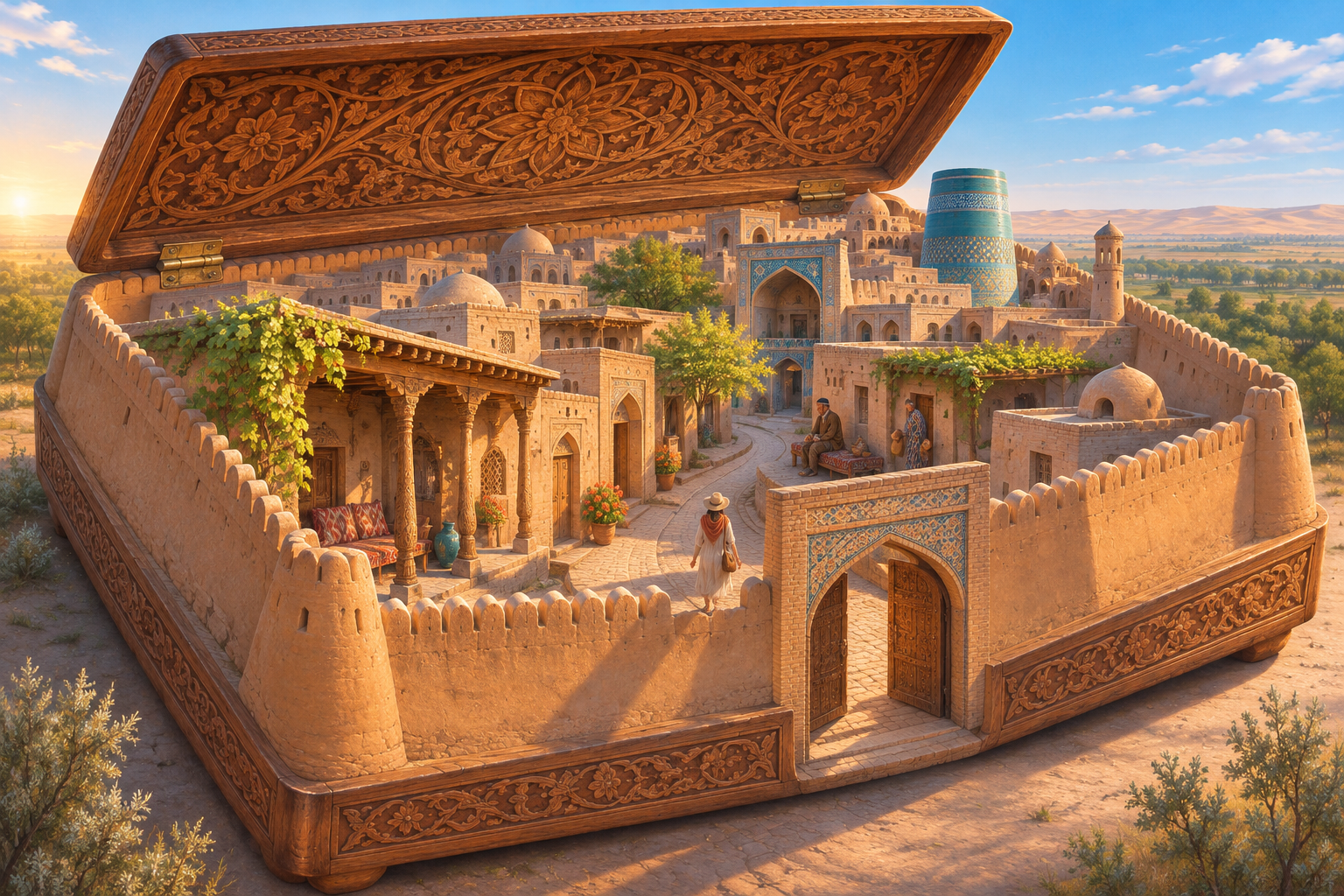
Most Uzbekistan itineraries treat Khiva as the third stop after Tashkent and Samarkand, squeezed in for a night before the flight back. That’s enough time to walk through the Ichan Kala and take the photos, but it misses what actually makes the city worth the detour — this is the most intact medieval walled city in Central Asia, not a reconstruction or a ruin, and it rewards the kind of slow afternoon wandering that one-night visitors never get to.
View larger map | Map data © OpenStreetMap contributors
Khiva sits in the Khorezm oasis at the western edge of Uzbekistan, a few kilometers from the Amu Darya river and about 450km from Bukhara by road. The closest airport is Urgench, 35km away, with domestic connections to Tashkent that take around two hours. Getting here from Bukhara by shared taxi takes the better part of a day across flat desert. That distance is part of why Khiva stayed preserved: it was never large enough to become a Soviet industrial city, so the Ichan Kala didn’t get demolished to make way for apartment blocks.
What the Ichan Kala Actually Is
The Ichan Kala is the inner walled city — roughly 400 by 650 meters, enclosed by mud-brick walls that reach 8 to 10 meters high in places. Within those walls are more than 50 historically significant structures: madrassas, mosques, minarets, mausoleums, the old khan’s palace. UNESCO designated it a World Heritage Site in 1990, among the first of the Soviet successor states to receive that status.
The useful comparison is Samarkand’s Registan. The Registan is three monumental facades arranged around a square — extraordinary, but you’re looking at it from outside. Inside the Ichan Kala you’re walking through a working city-within-a-city, with residential alleys, workshops, small tea houses, and guesthouses operating inside the same walls as the monuments. The scale is human rather than imperial, which is either what you came for or the thing that surprises you once you’re there.
The centrepiece most visitors photograph is the Kalta Minor minaret — a squat, turquoise-tiled tower that was never finished. Construction started in 1851, intended to be the tallest minaret in Central Asia, then stopped when Muhammad Amin Khan died and the project was abandoned. Its unfinished width relative to its height gives it an odd proportionality in person that photos consistently fail to capture. Worth seeing, but not the best thing in the city.
What to Actually Prioritize
The Tosh Hovli palace is more interesting than the more-visited Kunya Ark. Built between 1832 and 1841, it has 163 rooms across multiple courtyards — the harem sections in particular have some of the most detailed tilework in the city, floor-to-ceiling majolica in the kind of condition that makes you check whether it was recently restored (it wasn’t, mostly). The wood carvings on the iwans are worth stopping for specifically. Artisans from the Khorezm region developed a distinctive carved-wood tradition, and the quality in Tosh Hovli is demonstrably higher than what you’ll see at similar structures in Bukhara.
The Islam Hoja minaret and madrassa complex, built in 1908 — late, by Khiva standards — is at the eastern end of the Ichan Kala and gets fewer visitors than the turquoise minaret. You can climb it, and the view from the top is the best in the city: looking west across the full length of the Ichan Kala toward the desert beyond the walls. This is the practical reason to allow two nights. You have time to be at the top of that minaret at sunrise without rushing.
The Djuma mosque is easy to miss because the exterior is unassuming. Inside, 212 carved wooden columns support the roof — no two capitals are identical, and several of the columns date to the 10th century, salvaged from earlier structures on the same site. The light inside at midday comes through roof lanterns in a way that makes the forest of columns look genuinely different depending on where you’re standing. It takes about five minutes to register properly, which is five minutes most visitors on a one-night schedule don’t have.
Outside the Walls
The Dichan Kala, the outer city surrounding the Ichan Kala, is almost entirely ignored by visitors and worth at least a few hours. The neighborhoods immediately outside the western gate have traditional residential architecture — flat-roofed adobe houses, narrow lanes — that’s more authentically lived-in than anything inside the walls, which is now heavily oriented toward tourism. The Palvan Darvaza gate area has a small bazaar that serves the local population rather than tour groups.
If you have a third day, the Elliq Qala — ruins of pre-Islamic Khorezmian fortresses scattered across the Kyzylkum desert north and west of the city — are accessible by car from Khiva. The most impressive is Ayaz Qala, which has two citadels at different elevations with views across the desert that are qualitatively different from anything inside the Ichan Kala. Access requires either a hired car or a tour organized through one of the guesthouses inside the walls; there’s no public transport to the fortress sites. Budget two to three hours each way including time at the site itself.
Practical Details Worth Getting Right
The combined ticket for Khiva’s major monuments has been running roughly equivalent to $15–20 USD in recent years, though prices shift with inflation and the som exchange rate — verify current figures at the ticket kiosks inside the main gates when you arrive rather than relying on anything you read beforehand. The ticket booth opens around 8am and most sites stay accessible until early evening. Some attractions charge separately; the kiosks are straightforward about what’s included.
Staying inside the Ichan Kala is worth doing for at least one night. Several guesthouses operate in converted traditional houses, and being inside the walls at dawn and after the day-trippers leave at dusk is a different experience than commuting in from a modern hotel in Urgench. Rooms fill up quickly in peak season — May and September are the busiest months. July and August are genuinely harsh, with temperatures regularly above 40°C.
The heat is the one thing that can genuinely ruin a Khiva visit if you underestimate it. Late June through August is brutal: the mud-brick walls retain heat, the lanes are narrow and get little shade, and the monuments have almost no climate control. If your dates fall in that window, plan all monument visits for before 10am and after 4pm and treat midday as non-functional for sightseeing.
How Long You Actually Need
One night is enough to say you’ve seen Khiva. Two nights is enough to actually see it. Three nights opens up the desert fortress day trip and gives you the unhurried version of everything inside the walls — a full morning in the Djuma mosque before the groups arrive, the Islam Hoja minaret at the right hour, an afternoon in the Dichan Kala without a schedule.
Most itineraries give Khiva one night because it feels like the end of the line, and in a sense it is — you’re backtracking to Urgench regardless. But the same remoteness that makes it feel like a tail-end stop is what kept it intact. If you’re already making the trip to western Uzbekistan, the extra night is the one logistical change that shifts the visit from a box ticked to a place you’ll actually remember.