
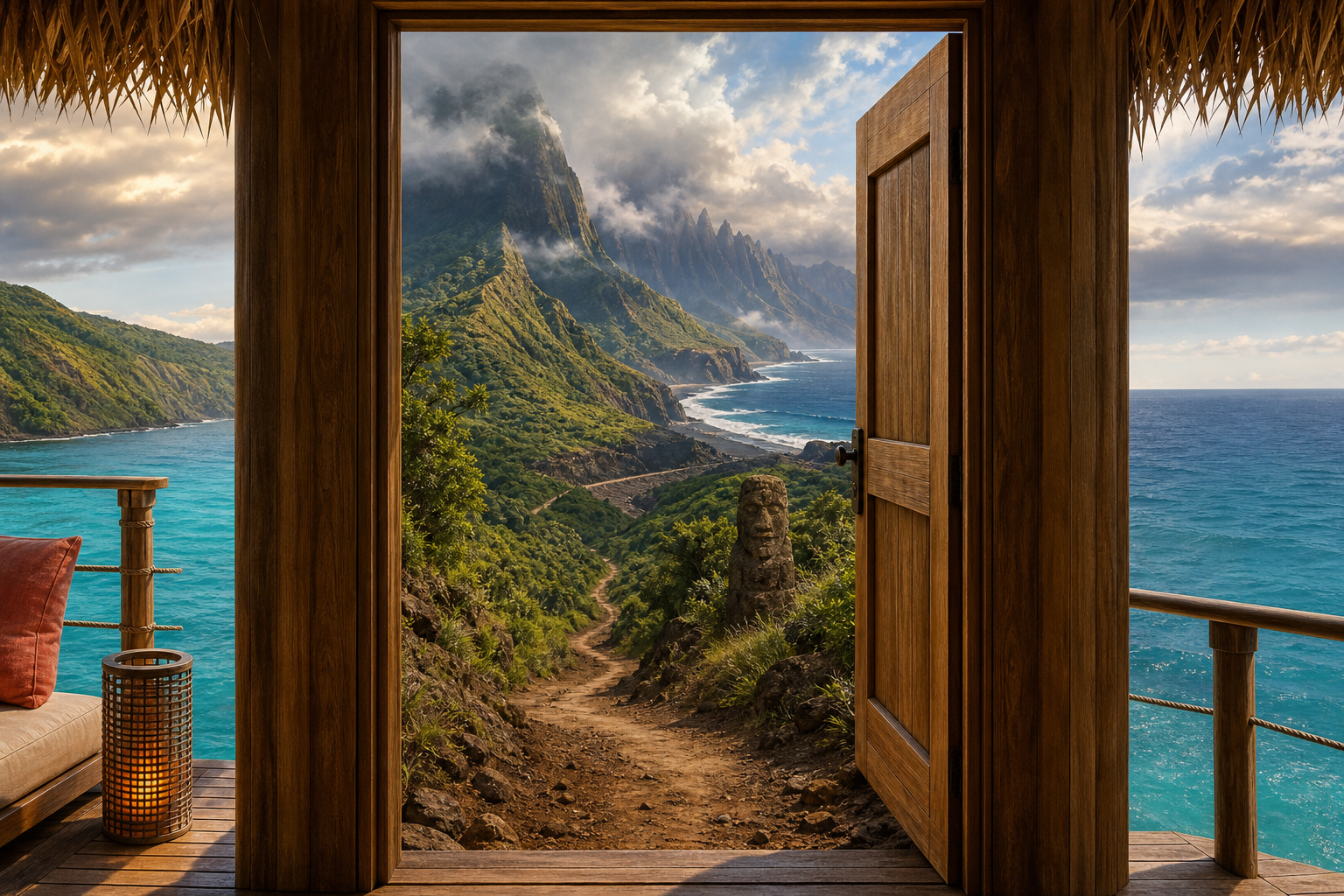
Most people who fly to French Polynesia never make it past the Society Islands — Bora Bora, Moorea, maybe Huahine if they’ve done their research. The Marquesas, 1,500 kilometers northeast, barely register. Hiva Oa, the main island in the southern Marquesas group, gets a few hundred serious visitors a month. That number is low enough to matter.
View larger map | Map data © OpenStreetMap contributors
There are no beach resorts here in any conventional sense. No overwater bungalows. The beaches that do exist are often black volcanic sand, and the ocean swells come in raw from open Pacific — this isn’t a swimming destination. What Hiva Oa has instead is dense green valleys dropping to cliffs, some of the most significant me’ae (sacred sites) in Polynesia, and a scale that makes the Society Islands feel like a different planet entirely.
Getting There Is the First Honest Reckoning
Air Tahiti operates the only scheduled service — a roughly 3.5-hour flight from Papeete to Atuona, the main village. Flights run several times a week but not daily, and they fill up. Book ahead, especially between July and October when the weather is driest and the handful of guesthouses are at capacity. There’s also an interisland supply ship, the Aranui, which runs a 14-day circuit visiting multiple Marquesan islands from Papeete — a legitimate way to cover several islands in one trip, though you’re working around the ship’s schedule rather than your own.
Atuona itself is a small village: a few hundred people, a couple of supermarkets, a gas station, a dock. It isn’t a disappointment so much as a calibration — it’s not a town in any European sense, but everything you need is there, including car rental through local operators. Renting a car isn’t optional if you want to see the island; the sites are spread across valleys connected by steep, often unpaved roads, and there’s no equivalent of a tour bus circuit.
The Two Graves Everyone Mentions — And Why They’re Actually Worth It
Paul Gauguin died in Atuona in 1903 and is buried in the Calvary Cemetery above the village. Jacques Brel, the Belgian singer-songwriter, chose the Marquesas as his final home and is buried in the same cemetery, a few meters away. The proximity of two very different artists who both chose this particular end of the world over everywhere else they could have gone says something real about the place, and the cemetery itself is quiet and perched above the bay in a way that earns the visit on its own terms.
The Paul Gauguin Cultural Center in Atuona is modest but honest — reproductions of the work he made here, context about the final years, enough biographical detail to understand why the Marquesas were specifically meaningful to him rather than just “far away.” The original canvases are in Paris and Copenhagen; the center doesn’t pretend otherwise, which counts for something.
Puamau and the Tiki That Actually Change Your Sense of Scale
The Me’ae Iipona at Puamau, on the northeast coast, takes about an hour and a half by 4WD from Atuona. The road crosses the island’s spine and drops into a different valley entirely, and the drive through the interior is not incidental — it’s one of the better reasons to make the trip.
The site contains the largest stone tiki in French Polynesia. The main figure, Taka’i’i, stands roughly 2.4 meters tall and has been in place for around 600 years. The figures were re-erected from collapsed positions in the 1990s with input from the local community alongside archaeologists — that process matters, because the site still feels like a place rather than an exhibit. Whether a restoration project preserves or somewhat alters that quality is a real question, but at Puamau the answer leans toward preserves.
Go with a local guide if at all possible. The family that maintains the site lives nearby and often shows visitors around personally. The cultural context for how these sites functioned — as spaces encoding both ritual and social hierarchy — takes more than a placard to grasp. Having someone explain the geography of power in where specific stones are placed is worth the guiding fee, which is modest.
What the Rest of the Island Rewards
The road to Taaoa valley, south of Atuona, passes another me’ae with additional tiki and stone platforms. Less visited than Puamau, less restored, more overgrown — which, depending on your tolerance for ambiguity about what you’re looking at, is either more atmospheric or just harder to read.
Hanakee, on the north side of the bay from Atuona, has the island’s main upmarket accommodation: the Pearl Lodge, bungalows on the hillside overlooking the water. It’s the closest thing to a conventional hotel on Hiva Oa. Book well ahead; it’s small and the peak season fills it months out.
Atuona village itself rewards an unhurried morning — the covered market, the quai where fishing boats come in, the bakery producing baguettes that somehow taste correct despite sitting at the end of a very long supply chain. One of the specific pleasures of the remoter French Polynesian islands is that French administrative infrastructure arrived alongside everything else, which means decent bread is genuinely available on a Marquesan mountainside.
Practical Realities Worth Knowing
Everything is expensive — Hiva Oa is costly even by French Polynesia standards, because supply chains are long and demand is thin enough that nothing keeps prices competitive. The mid-range hotel tier that exists on Moorea or Huahine doesn’t exist here. Budget accordingly before you go, not after you arrive.
The Marquesan climate doesn’t follow the same logic as Tahiti. Hiva Oa is wetter and more rugged, and the valleys trap cloud in ways that can make any given day unpredictable regardless of month. July through September is the most reliably dry window. The rest of the year isn’t monsoon-level wet, but the road to Puamau can become genuinely difficult after heavy rain. Ask your accommodation the night before about current road conditions before committing to the drive.
One real limitation: structured tourism infrastructure is thin. The sites are accessible, locals are welcoming, but if you need a full itinerary of pre-booked activities to feel like a trip is working, Hiva Oa will feel sparse. It’s an island that rewards people comfortable leaving a day open and seeing what it produces.
How Long to Stay
Three nights is the floor. One day for Puamau and the trans-island road, one day for Atuona’s center, the cemetery, and the nearby valley sites, and one day you haven’t planned — either for a repeat visit somewhere, or for the sitting-with-it time that’s actually part of why you came this far.
Five nights makes more sense if you’re combining with another Marquesan island. Nuku Hiva, the largest in the group, is to the north and has its own significant archaeological sites and the dramatic Hakaui Valley. The two islands together cover the Marquesas more completely than either does alone, and Air Tahiti runs interisland connections between them.
If you’ve already decided the Society Islands are mandatory, treat the Marquesas as an extension that changes the texture of the whole trip — not an alternative to Bora Bora but a corrective to it. The overwater bungalow is designed to be comfortable. Hiva Oa is designed to be somewhere.