
Brazzaville Sits Across the River from Kinshasa and Gets Ignored for It
View larger map | Map data © OpenStreetMap contributors
Most travelers who end up in Brazzaville are transiting to Gabon, Cameroon, or the Central African Republic, or they’ve already done the DRC side of the river and want to say they crossed. That undersells it. The Republic of Congo’s capital is a genuinely interesting city that most Africa-focused itineraries skip without much deliberation — not because it disappoints people who go, but because it doesn’t have an obvious hook. No gorillas. No singular ancient monument to anchor a tour group’s schedule. What it has instead is atmosphere, some legitimately good food, and a compact enough footprint that two or three days actually covers it properly.
Getting There — and What to Sort in Advance
Maya-Maya International Airport (IATA: BZV) has direct connections to Paris on Air France, and regional connections through Addis Ababa on Ethiopian and Nairobi on Kenya Airways, plus a handful of West African hubs. It’s not a well-connected airport by regional standards, which is partly why the city ends up off most itineraries. From Europe, the Paris route is the cleanest path. From East or West Africa, expect a connection.
Visa requirements depend heavily on your passport — Congo-Brazzaville is not a visa-on-arrival destination for most nationalities, and that paperwork needs to be sorted before you fly. The process takes time and isn’t always predictable. Don’t book a non-refundable itinerary around Brazzaville before the visa is in hand. That’s a genuine constraint, not boilerplate caution.
The River Is the Central Fact of the City
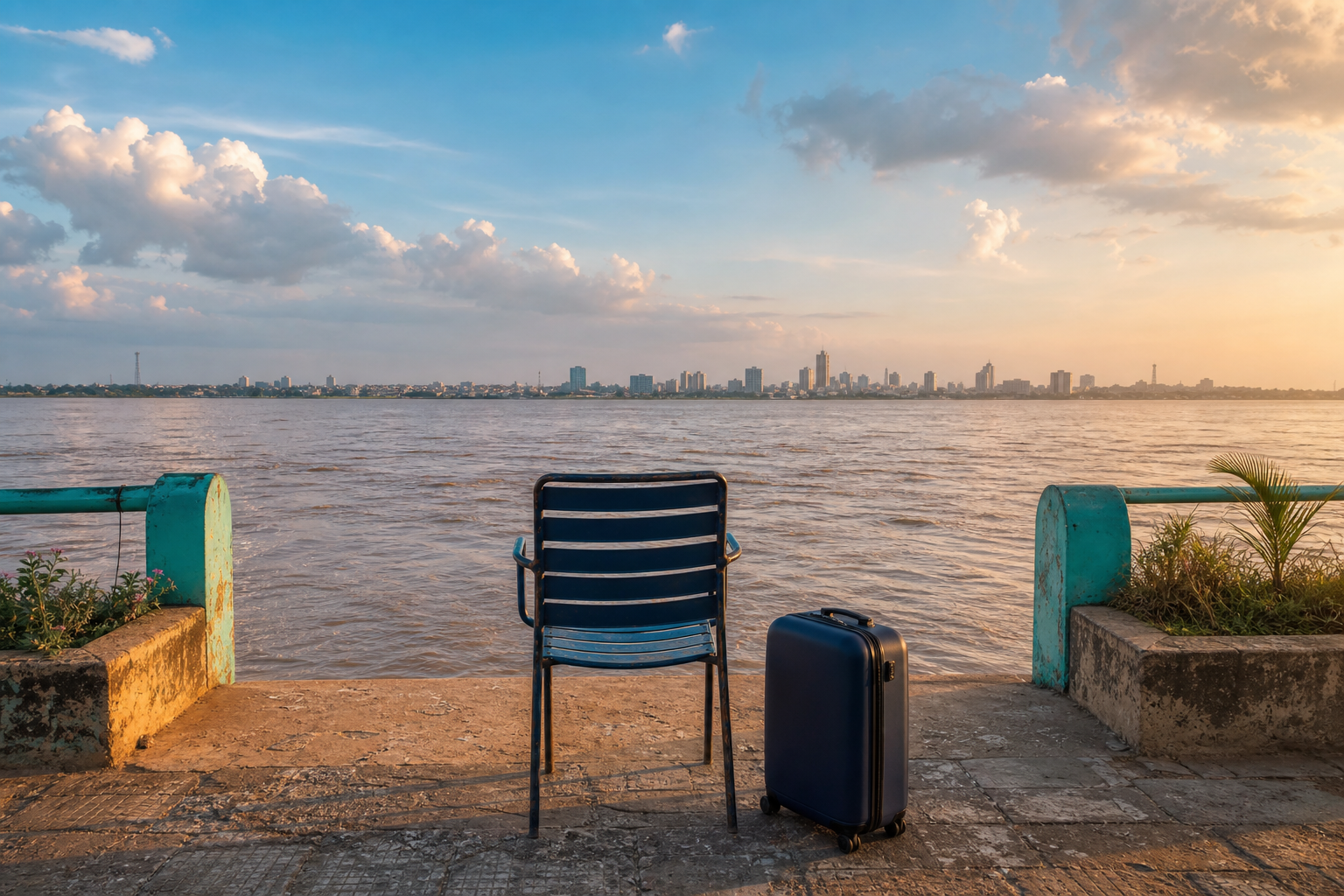
The Congo River at Brazzaville is not scenic in a postcard sense — it’s enormous and brown and moving fast, and across the water you can see Kinshasa’s skyline, which makes for one of the stranger urban views anywhere: two national capitals facing each other across a few kilometers of river. That crossing — by pirogue (motorized canoe) or by the official beach ferry — is worth doing even if you only go to Kinshasa for a few hours. The two cities feel completely different on the ground despite sharing a bank. Brazzaville is quieter, less chaotic, more Francophone in its bones.
The Corniche, the riverside promenade running along the Congo, is where the city comes to life in the late afternoon. It’s functional rather than manicured — food vendors, families, men watching football on phones — but that’s the point. Sit somewhere and watch the river for an hour. The scale of it takes time to actually register.
What’s Actually Worth Going to See
The Basilique Sainte-Anne du Congo
Built in 1949, still striking from the outside — a concrete modernist structure with a painted interior that feels genuinely unusual for the region. It doesn’t appear on most lists because it’s not ancient, but the interior murals are rendered in a distinctly Central African visual idiom rather than a European colonial one, and they reward looking at slowly. Free to enter, almost never crowded.
The Poto-Poto Neighborhood and Its School of Painting
Poto-Poto is the oldest African neighborhood in the city, and the École de Peinture de Poto-Poto, founded in 1951, is one of the more significant art institutions in Central Africa even if it registers almost nowhere on the international gallery circuit. The style developed here — flat planes of color, stylized human figures, deeply local subject matter — influenced painters across francophone Africa for decades. You can visit the school, see work in progress, and buy directly from artists. Prices are negotiable and reasonable. Don’t expect a polished gallery experience; expect an actual working studio.
The Presidential Palace Area (Viewed, Not Entered)
The area around the Palais du Peuple is architecturally interesting in the way Cold War-era African government buildings often are — grand ambitions, Soviet-influenced concrete, now somewhat battered. Do not try to photograph this area without asking first. Security presence is real and unpredictable. The surrounding neighborhood, however, is worth walking through.
Food — This Is Underrated
Congolese cuisine in Brazzaville doesn’t get written about much, which is a real gap. Poulet nyembwe — chicken cooked in palm nut sauce — is the dish worth tracking down, and any spot making it fresh rather than from a tin is worth the extra walk. Saka-saka, cassava leaves cooked down with smoked fish or peanuts, is the everyday food most visitors never try because they stick to hotel restaurants. Don’t do that.
Marché Total is the city’s main market and the right place to eat lunch — cassava fritters, grilled fish, plantain — if you’re comfortable eating at market stalls, which in Brazzaville is generally fine for anyone with a reasonably robust stomach. The more cautious option is the Ponton neighborhood along the Corniche, which has sit-down restaurants with better-than-expected kitchens.
Brazzaville also has a genuinely good bar scene relative to its size, partly a legacy of the city’s years as a regional French administrative center. The local Ngok beer is drinkable and cold, which covers the basics.
The Kinshasa Day Trip Question
Crossing to Kinshasa requires a separate DRC visa — for most passports, not available on arrival at the beach crossing, so it needs sorting in advance. If you have it, cross. Kinshasa operates at a completely different scale (population estimates for both cities are rough, but the gap is large), and the contrast is immediate the moment you land on the other bank. If you don’t have the DRC visa sorted, the view from the Corniche will have to do.
When to Go and How Long to Spend
The Republic of Congo has two wet seasons — roughly March through June and October through December — and two dry seasons. The main dry season, June through September, is the most comfortable time to visit. Harmattan dust from the north can make the air hazy during this period, but that’s a minor trade-off against sustained afternoon rain. Temperatures are relatively stable year-round; Brazzaville sits south of the equator at moderate elevation and doesn’t get the brutal interior heat of the DRC’s basin.
Two full days covers the city properly without rushing. Three days gives you time to take the river seriously and have an unhurried meal somewhere worth the time. More than that and you’re either doing the Kinshasa crossing or spending time that could go somewhere else on the routing.
The Honest Practical Note
Brazzaville doesn’t have a well-developed tourist infrastructure. Reliable hotels exist — several international chain properties are solid — but mid-range options are thinner than in comparably sized African capitals, and budget travel is harder here than in most of West Africa. Cash still runs most transactions; bring francs CFA or accept that ATMs will be unreliable. And the French is real — English is spoken far less here than in Nairobi or Accra. If your French is shaky, lean on it anyway; it gets further than you’d expect.
The visa and the limited flight connections are the two concrete barriers keeping Brazzaville off most itineraries. Neither is insurmountable — they just require sorting before you go. The question worth sitting with when you’re building a Central or West Africa routing: how much of what you’re skipping is actually hard, and how much of it is just unfamiliar paperwork?