
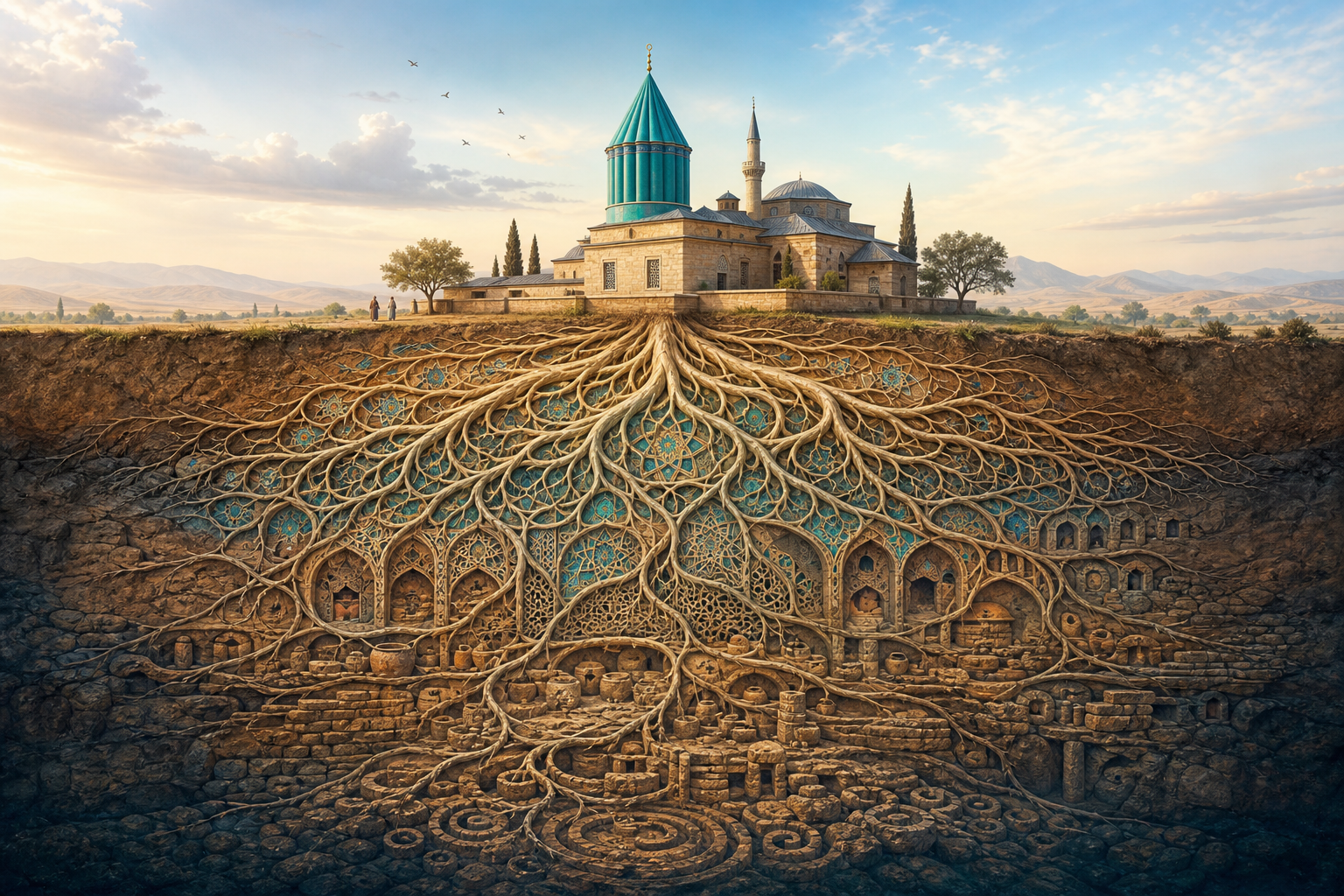
Konya doesn’t appear on most Turkey itineraries, and when it does, it’s usually as a half-day stop between Cappadocia and the coast — someone has enough time to photograph the Mevlâna Museum and move on. That pattern misses almost everything worth being there for.
View larger map | Map data © OpenStreetMap contributors
The city is the spiritual home of Sufism. Rumi — the 13th-century poet whose work is now apparently the best-selling poetry in the United States — lived, taught, and died here. The Mevlâna Museum, housed in the lodge where the Mevlevi Order was founded, contains his tomb and draws hundreds of thousands of visitors a year. Unlike a lot of religious sites turned heritage attractions, this one is still genuinely active. People come to pray, not just photograph. That distinction matters when you’re deciding how to move through it.
What the Mevlâna Museum Actually Is
It’s a türbe complex — a tomb shrine — set inside a former dervish lodge, with a mosque added later. The architecture is worth studying before you go in: the fluted turquoise dome is one of the more recognizable shapes in Anatolian religious architecture, dating from the 15th century. Inside, Rumi’s sarcophagus sits under a canopy of embroidered cloth surrounded by calligraphy panels, and the adjacent rooms contain manuscripts, musical instruments from the Sema ceremony, and items of extraordinary craftsmanship that most visitors walk past too quickly to actually register.
Go on a weekday morning if you have a choice. Weekend afternoons get crowded in a way that makes the interior feel chaotic, and the spiritual weight of the place — which is real, not constructed — dissipates entirely in that kind of traffic.
The Sema Ceremony — When and How
The whirling dervish ceremony performed by the Mevlevi Order isn’t a performance in the commercial sense, though a staged version runs for tourists in various Turkish cities. In Konya, the Sema happens on Saturday evenings at the Cultural Centre near the museum — free, run by practitioners, not a tourism operation. Arrive early because seating fills. The ceremony runs roughly 90 minutes. It’s slow and deliberate and nothing like the quick clip you’ve seen in travel videos.
December is when attendance peaks sharply — the anniversary of Rumi’s death falls on December 17th, and the city hosts a week-long commemoration drawing practitioners from across the world. If your dates are flexible and you want to see the ceremony in its fullest context, that’s the week to be there. The trade-off is real: accommodation prices spike and the museum itself becomes very crowded.
Alaeddin’s Hill and the Old City
Alaeddin Tepesi sits at the center of the city and has been occupied continuously since the Bronze Age. The Alaeddin Mosque on top of it, completed in the 13th century under the Seljuks, is Konya’s oldest. The hill itself is now a park where locals come in the evenings — one of the better places in the city to just sit and watch rather than consume anything in particular.
The Karatay Medrese, a five-minute walk from the hill, is worth prioritizing over several more famous stops. Built in 1251 and now serving as a tile museum, its interior dome is covered in a mosaic of turquoise and cobalt tiles that represents one of the best intact examples of Seljuk ceramic art anywhere. Most visitors spend 20 minutes here. You could spend an hour.
İnce Minare Medrese
The Slender Minaret Medrese sits close to the Karatay and houses a collection of stone and wood carvings. The minaret itself lost its upper half to a lightning strike in the 18th century, which gives the building an unintentionally striking silhouette. The carved portal stonework on the entrance is exceptional — the geometric interlace and arabesque detail is the kind of thing that makes more sense in person than in any photograph of it.
Food in Konya
Konya is not a place to eat around the tourist drag near the museum. The city has its own regional culinary identity, distinct from the grilled-meat defaults of Istanbul tourism. Etli ekmek — a flatbread topped with ground lamb, stretched to roughly a meter long and cooked in a wood-fired oven — is the dish the city is genuinely known for, and dedicated etli ekmek restaurants are easy to find across town. Firin kebab, a slow-roasted lamb dish, is the other one worth ordering.
The bazaar area around the Aziziye Mosque has the density of working food stalls and small restaurants that serve locals rather than visitors. Prices run noticeably lower than Istanbul for equivalent quality. Konya is a conservative city — alcohol isn’t widely available and many restaurants don’t serve it, which is worth knowing before you sit down rather than after.
Çatalhöyük: The Actual Reason to Add a Day
About 50 kilometers southeast of Konya sits Çatalhöyük, one of the earliest urban settlements ever excavated — occupied roughly 9,000 years ago, a Neolithic settlement of several thousand people with no streets, houses entered through roof holes, and walls decorated with murals. UNESCO listed it in 2012. Most visitors who make it to Konya don’t make it here, which is genuinely puzzling given the scale of what was found.
Getting there without a car is awkward — there’s no reliable public transport directly to the site. A taxi from Konya for a half-day is the practical solution. An on-site shelter protects parts of the excavation and a small museum explains the layout and findings. It’s dry and exposed, so go in the morning before the heat becomes a problem — temperatures in July and August regularly push above 35°C.
The honest caveat on Çatalhöyük: the visual experience at the site is limited. You’re looking at excavated mud-brick foundations and some reconstructed interiors. The significance is archaeological and historical, not scenic. If that kind of thing engages you, it’s extraordinary. If you need ruins to look dramatic, this isn’t that.
Getting There and How Long to Stay
Konya has its own airport (KYA) with domestic connections from Istanbul, though high-speed rail to Ankara takes about two hours and puts you in reach of connections across the country. The train station sits close to the center. If Cappadocia is part of the same trip, Konya is a logical stop in either direction — roughly 230 kilometers from Göreme on a straightforward road.
Two full days is the right amount of time. One day isn’t enough — you end up doing the museum and the hill and leaving before the city’s actual rhythm becomes legible. Three days is probably one too many unless you’re combining the Sema ceremony with a Çatalhöyük excursion.
Spring (April–May) and early autumn (September–October) give you the best conditions: mild temperatures, no summer heat, the city in a normal operating state rather than peak pilgrimage mode. Accommodation runs inexpensive compared to Cappadocia or Istanbul, with no shortage of options near the museum.
If your current Turkey itinerary runs straight from Istanbul or Ankara to Cappadocia, Konya is the stop that changes the character of the whole trip. Less scenic, more substantive — and the only place in the country where you can watch a Sema ceremony that isn’t being performed for your benefit.