
Most Egypt itineraries give Aswan about four hours: the Philae temple, a quick look at the unfinished obelisk, and then back to the airport or overnight train north. The logic makes sense on paper — Cairo and Luxor have more famous sites, more density of things to see, and more direct flights. But it means most visitors leave having seen Aswan’s attractions without ever actually experiencing the city, which is a different thing entirely.
View larger map | Map data © OpenStreetMap contributors
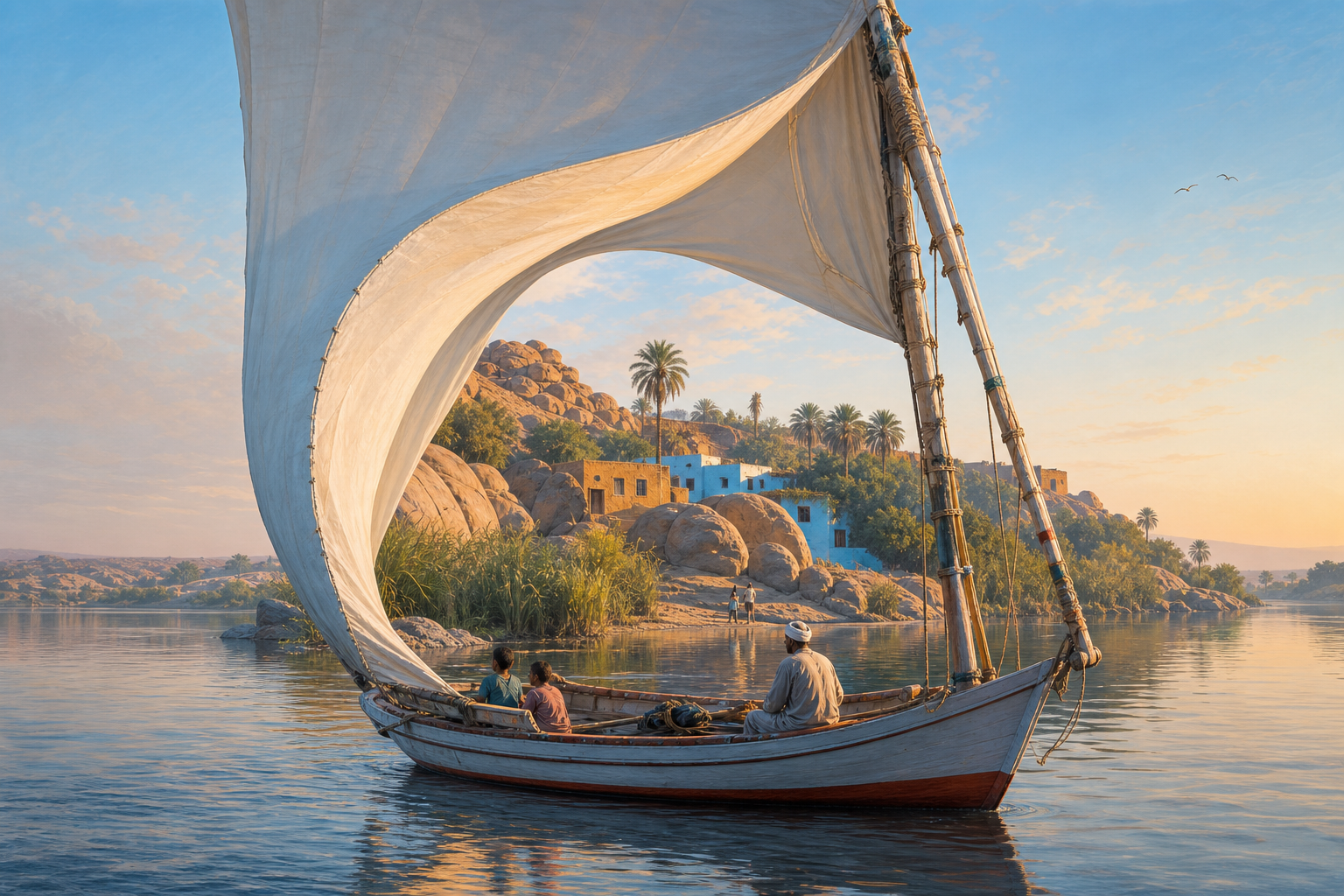
Aswan is the southernmost city in Egypt proper, right at the edge of where the Nile narrows before Sudan. The pace is slower than Luxor, the tourism infrastructure is lighter (in a good way, mostly), and the city sits on a stretch of river that’s genuinely beautiful — granite boulders, felucca sails, the Elephantine Island palm groves — in a way that Cairo’s brown-grey horizon never really is. Two full days here is a reasonable minimum. Three is better.
Philae Temple: Yes, It’s Worth It — But Go at the Right Time
Philae is the one thing almost everyone does, and it earns the attention. The temple complex dedicated to Isis was dismantled block by block and relocated to its current island — Agilkia — as part of a UNESCO-led salvage operation in the 1960s and 70s after the Aswan High Dam flooded the original site. The engineering effort behind that rescue is nearly as interesting as the temple itself, and the visitor experience benefits: the setting on a small island surrounded by reservoir water feels remote in a way that few ancient Egyptian sites still manage.
Go before 8am if you can, when the light on the sandstone is warm and the cruise ship crowds haven’t landed yet. The boat crossing from the Shellal dock takes about ten minutes. Skip the evening sound-and-light show unless you’re specifically into that format — the commentary is dated and the lighting is garish in the way all sound-and-light shows are.
The Unfinished Obelisk Is More Interesting Than It Sounds
The site most itineraries treat as a checkbox is worth a real look. The obelisk is lying in the granite quarry where it was cut, still attached to the bedrock — abandoned mid-construction around 1500 BCE, apparently because a crack developed in the stone. Completed, it would have been the largest obelisk ever cut: roughly 42 meters tall, around 1,200 tons.
What makes it interesting isn’t the obelisk itself — it’s the question of how ancient Egyptians were planning to move it. The quarry marks and tool traces are still visible in the granite. The logistics of extracting and transporting something at that scale, without metal tools or wheeled vehicles, remain genuinely unresolved in the archaeological literature. Spend an hour here instead of fifteen minutes and it starts to feel less like a failed monument and more like an open engineering problem that nobody has closed.
The West Bank and the Nubian Villages
The east bank is where almost all the tourist sites sit. Cross to the west bank by local ferry — not a tourist felucca, the public crossing that costs almost nothing — and the dynamic changes immediately. The Nubian villages on both the west bank and Elephantine Island are the places most day-trippers never reach, and they’re the part of Aswan with the most distinct character.
Nubian culture is recognizably different from northern Egyptian culture: the architecture runs to deep blues and ochres on the house walls, the food is different, and the history runs deeper than the Islamic period that dominates the north. The Nubian Museum in the city is the most useful single introduction to this — it covers the pre-pharaonic Nubian kingdoms, the Meroitic civilization, and the impact of successive dam constructions on Nubian communities who were relocated multiple times through the 20th century. It’s not a cheerful history, and the museum doesn’t pretend it is. Worth two hours.
A Felucca Overnight Is the One Cliché That Actually Delivers
Felucca trips between Aswan and Kom Ombo — usually one or two nights — have been on every budget travel list for decades, which makes them feel like something to be suspicious of. They’re not. A slow sail on the Nile at sunset, sleeping on the boat under a canvas canopy with no phone signal, is one of the more genuinely restorative things available in Egypt, and it costs very little compared to a Nile cruise ship.
A few things to get right: negotiate the price before you leave the dock, not once you’re on the water. Establish whether food is included and what that actually means in practice. The weather between October and April is excellent for this — warm days, cool nights, manageable winds. From June through August the heat is severe enough that daytime sailing is genuinely unpleasant rather than just warm.
Abu Simbel: The One Day Trip That Justifies the Effort
Abu Simbel is two and a half hours south of Aswan by road — technically a different governorate, on the shore of Lake Nasser near the Sudanese border. The two temples built by Ramesses II are among the most dramatic ancient structures anywhere, partly for the scale (four seated colossi each 20 meters high, carved directly into the cliff face), and partly because these were also relocated by the UNESCO salvage operation in the 1960s: cut into blocks and reassembled 65 meters uphill and 200 meters inland to escape the rising waters of Lake Nasser. The precision of that relocation is what stays with you — the interior astronomical alignment was maintained so that sunlight still reaches the innermost sanctuary on the same two days each year it always did. That’s not a talking-point statistic; you can look up the engineering records through UNESCO’s documentation on the Nubia Campaign.
Most visitors go as part of the convoy that leaves Aswan around 4am and returns by midday. The early start is worth it: the sites are relatively quiet by the time you arrive, and you’re back before the afternoon heat becomes a problem. Flying is an option — there’s a small airstrip at Abu Simbel — but the road convoy is cheaper, and crossing that stretch of desert actually helps frame the site’s remoteness in a way the flight doesn’t.
Practical Notes
Aswan has a domestic airport with connections to Cairo; the overnight train from Luxor or Cairo is slower but more comfortable than the budget carriers. The main tourist season runs October through March. Visiting in July or August is physically demanding in a way worth taking seriously — temperatures regularly exceed 42°C (108°F). That’s a real logistical constraint, not a scare: morning-only touring, full shade and water management by noon, and adjusted expectations for afternoons.
Most mid-range hotels sit on the corniche overlooking the river, which is where you want to be. Several of the older properties have Nile-facing rooms that look directly onto the granite islands and the water. The Old Cataract is the famous one — the view at dusk, with feluccas moving through it, is exactly as good as it looks in photographs, though the room rates have climbed well past what the experience adds over a much cheaper corniche hotel next door.
One genuine caveat: the hawking around the major sites — boat captains, guides, souvenir sellers — is persistent in a way that wears on some travelers faster than others. It’s not aggressive by Cairo or Luxor standards, but it’s constant. Arriving with firm, polite refusals already practiced saves a real amount of mental energy over a two- or three-day stay.
Book Abu Simbel transport at least a day ahead through your hotel rather than through corniche touts — the convoy departure times are fixed and don’t change, but the price and reliability of who actually takes you varies considerably.