
Funchal Is Not the Island
View larger map | Map data © OpenStreetMap contributors
Most people who visit Madeira never really leave Funchal. The capital has the hotels, the cable car, the famous toboggan ride down from Monte, and a waterfront that’s genuinely pleasant. It earns a day or two. But the island is 57 kilometers long and deeply creased with valleys, and treating Funchal as the destination rather than the entry point is the most common mistake visitors make.
The interior and the north coast are a different island entirely — wetter, greener, emptier, and much more interesting to actually walk through.
The Levada System Is Worth Understanding Before You Arrive
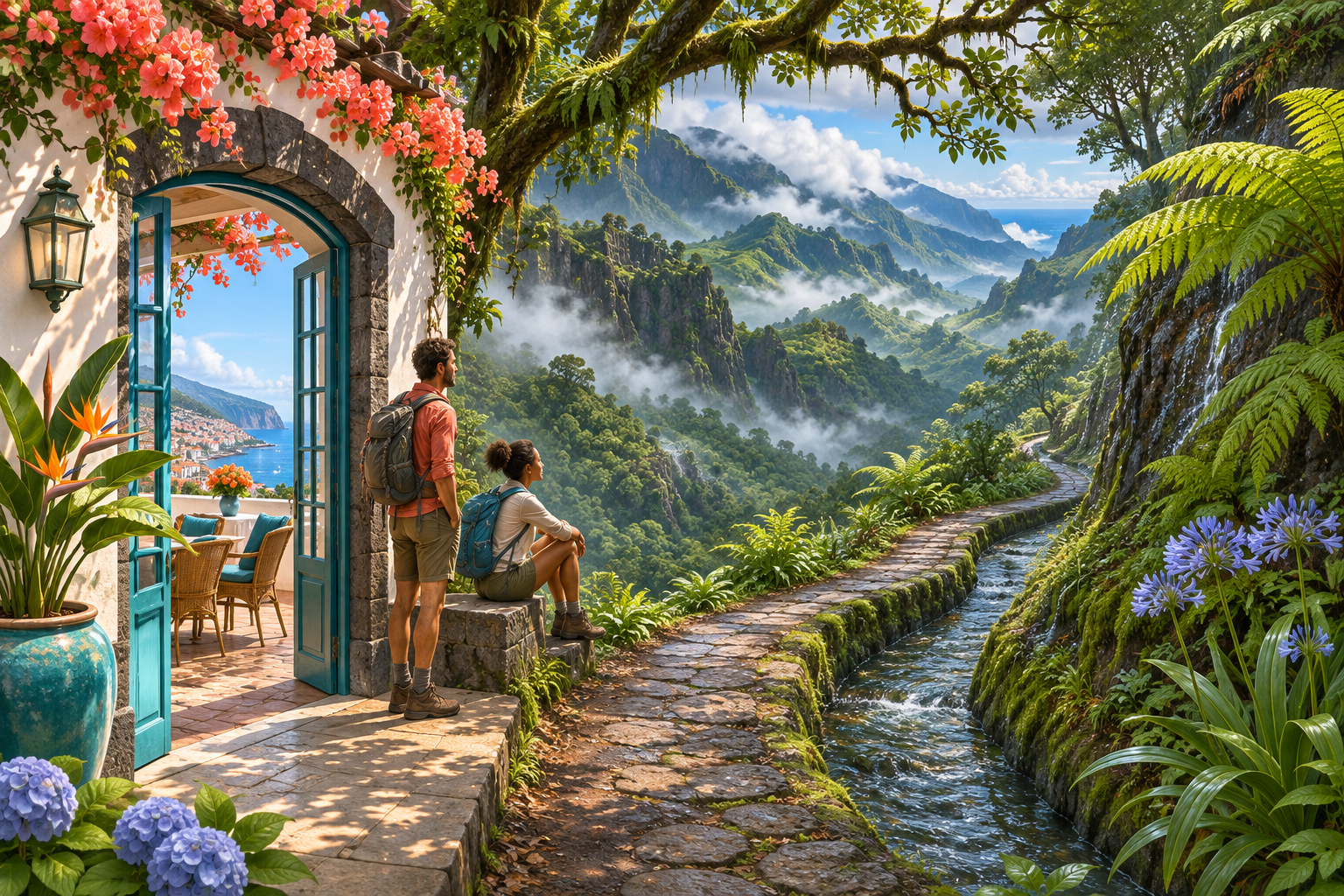
Madeira’s levadas are irrigation channels built from the 15th century onward to carry water from the wet northern highlands down to the drier agricultural south. There are roughly 2,500 kilometers of them, and most have a narrow footpath running alongside — which is how the island ended up with one of the more unusual trail networks in Europe.
The best levada walks aren’t the ones closest to Funchal. Levada do Caldeirão Verde, starting from Queimadas park above Santana, runs through laurisilva forest — the ancient laurel forest that covered much of southern Europe before the last ice age and now survives mainly here and in the Canaries. It’s a UNESCO World Heritage-listed ecosystem and it looks unlike anything on the European mainland. The trail is relatively flat (levadas have to be — they’re carrying water under gravity) but runs about 13 kilometers round trip with four tunnel sections, the longest around 350 meters. Bring a headlamp. The tunnels are pitch dark with uneven floors cut from rock, and this is not the kind of thing you improvise around.
Levada das 25 Fontes in the Rabacal area is the other one worth prioritizing: shorter and more dramatic, ending at a basalt amphitheater where 25 springs feed a waterfall into a green pool. The drive to the trailhead across the Paul da Serra plateau is worth the trip on its own.
One real caveat: several of the most popular levada trails have been closed or rerouted repeatedly after rockslides and fires. The 2017 and 2022 fires affected trail access in ways that still aren’t fully resolved. Check trail status at trails.visitmadeira.com before committing to any specific route — what was open two years ago may not be open now, and finding a tunnel gated shut two kilometers in is a specific kind of frustrating.
The North Coast Isn’t a Day Trip Shortcut
São Vicente, Porto Moniz, and Seixal are driveable from Funchal in roughly 90 minutes via the expressway tunnels. But they’re not really day trip material if you want to understand them rather than photograph them and leave.
Porto Moniz has the natural lava rock pools that show up on every Madeira roundup. They’re real and genuinely good for swimming — the Atlantic swells are blocked by the basalt formations and the pools stay calmer than you’d expect given what the open sea is doing ten meters away. But the town closes up early, and the pools at high tide are partly submerged. Timing matters: go at low to mid tide on a day without heavy swell, ideally a weekday morning before the tour coaches from Funchal arrive around 11am.
Seixal, a few kilometers east, has a small black sand beach that’s less visited and worth the detour. The waterfall that runs directly onto the road at Véu da Noiva just east of Seixal is one of those things that stops being cliché when you’re actually driving underneath it.
Santana Is Where to Actually Slow Down
Santana is known for its palheiros — the triangular thatched houses that feature in every Madeira postcard. The restored ones near the town center are tourist infrastructure rather than living heritage, but they’re not uninteresting; the form is genuinely old and adapted to the specific weather conditions of the north coast.
What makes Santana worth more than an hour is the surrounding terrain. The road up to Queimadas and the Caldeirão Verde trailhead passes through landscape that’s genuinely hard to describe without sounding like a brochure. The fog moving through the laurel forest in the morning doesn’t burn off the way it does further south — it’s tied to the cloud inversion layer that sits over the central highlands most of the year, and it comes and goes all day regardless of what the forecast says.
There’s a small government-run park house at Queimadas with picnic facilities. It gets cold up here even in summer; a layer is not optional, whatever the weather looks like down in Funchal.
Câmara de Lobos Is the One Funchal-Adjacent Place Worth Going
Five kilometers west of Funchal, Câmara de Lobos is a fishing village that Churchill painted during his 1950 visit — there’s a plaque at his viewpoint. The tourism around that fact is low-key enough not to ruin the place. The harbor is active, the village above it is unreconstructed and genuinely lived-in, and the cliff at Cabo Girão — 580 meters above the sea, one of the highest sea cliffs in Europe — is ten minutes further west and free to visit.
Câmara de Lobos is also where poncha originates: the local spirit made from aguardente de cana (sugar cane rum), honey, and lemon or passion fruit. It is stronger than it tastes. Order it at a local bar rather than a hotel terrace and the price drops significantly.
Practical Notes
Getting around without a car is genuinely difficult outside Funchal. The bus network exists but runs infrequently to the interior and north, with schedules built around local commutes rather than tourist timing. Renting a car for at least two or three days is the only realistic way to see the island properly. The roads are narrow, steep, and occasionally alarming — the old cliff tunnel between Ribeira Brava and São Vicente is a specific example — but driving here tends to be slower than the map suggests rather than faster.
Funchal’s hotel options range from large seafront resorts to small quintas in the hills above the city. For a base that makes the interior more accessible, the quintas above Funchal — older estate houses converted to small hotels — sit in the laurel forest zone rather than on the coastal strip and are often better value than the famous seafront properties. Reid’s Palace is the historic flagship if that’s the kind of trip you’re on, but it’s not the only option worth knowing about.
The shoulder season question is simpler here than most places: Madeira doesn’t have a bad season in the same way. The north is wetter year-round; the south is reliably mild. The Flower Festival in April fills Funchal completely and pushes hotel prices up across the island — if the festival itself isn’t your reason to come, that’s the window to avoid. August has the same problem around Assumption Day.
What Actually Takes Time
The levadas are why this island has a reputation among walkers that most Atlantic island destinations don’t earn. But they reward planning rather than improvisation — trail closures, tunnel access, and the gap between what looks short on a map and what a narrow cliff-edge path with significant exposure actually takes in real time are all genuine variables.
Before you book: are you coming to Madeira for the island, or for the convenient Atlantic flight time and the fact that it looks good in photos? Both are legitimate. But only one of them justifies staying more than three nights — and three nights isn’t enough to do the north coast, two serious levada walks, and understand Funchal at the same time.
Give it five days if the terrain is the actual draw. And book the car before the hotels.