
Why Plovdiv Gets Shortchanged
View larger map | Map data © OpenStreetMap contributors
Most Bulgaria itineraries go Sofia-Plovdiv-Veliko Tarnovo in that order, allocating Plovdiv a single night as a scenic waypoint. That’s enough to walk through the old town and take the photos, but it’s not enough to understand why the city has been continuously inhabited for somewhere around 6,000 years — which makes it one of the oldest cities in Europe by any honest count, older than Rome and Athens by several centuries.
One night gives you the postcard. Two full days give you something closer to the actual place.
The Old Town Is Real, Not a Reconstruction
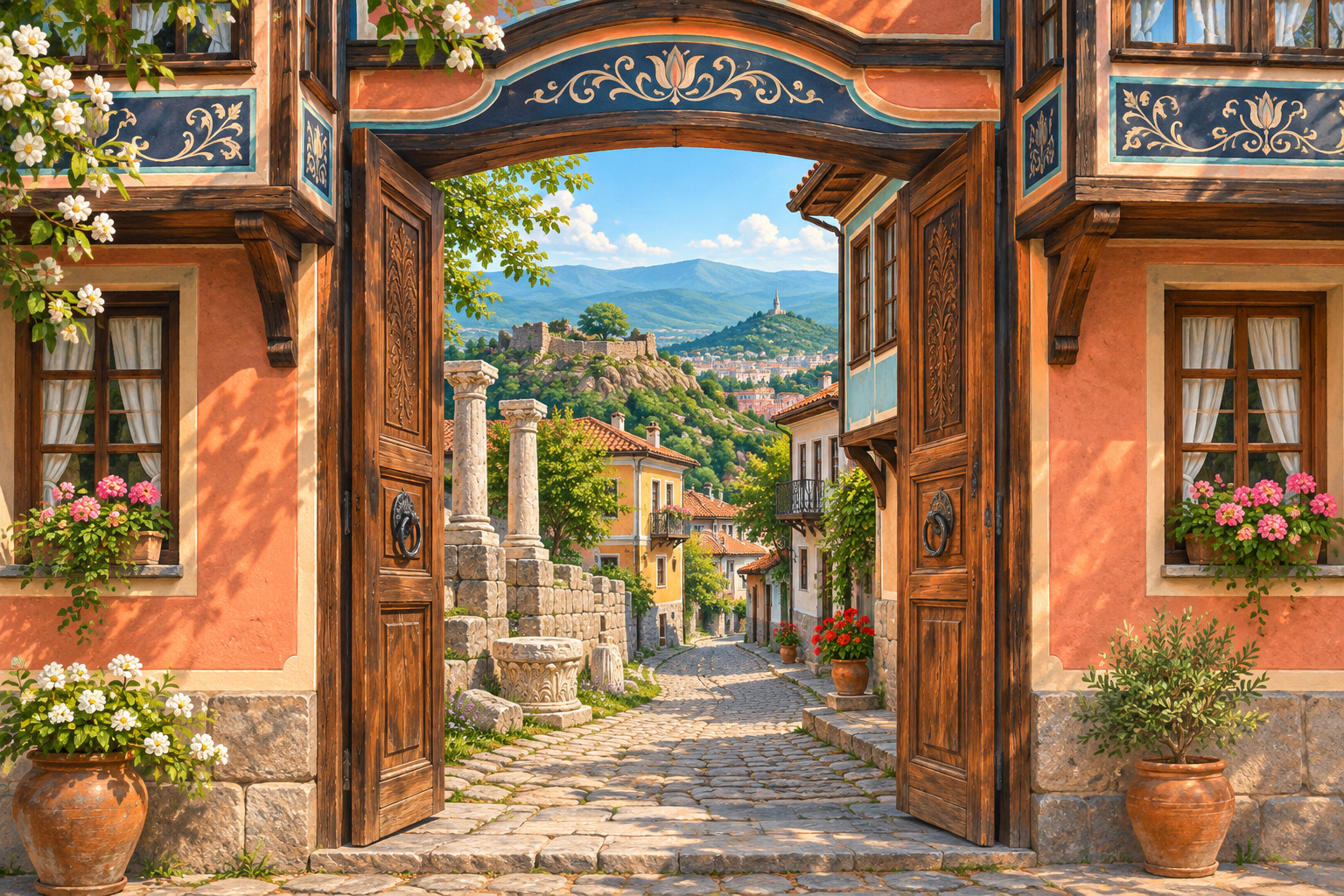
Plovdiv’s Kapana neighborhood and the old town (Stariat Grad) get lumped together in most descriptions, but they’re distinct in character and worth treating separately. The old town sits on one of three hills — the Trimontium — and contains a dense cluster of National Revival-era houses, most of them 18th and 19th century, with overhanging upper storeys and vivid painted facades that became a Bulgarian architectural signature. Some are private residences. Some are museums. Several are both, technically.
The Hindliyan House and the Balabanov House are the two most visited interiors, and both are worth going inside rather than just photographing the exterior. The Hindliyan has painted wall murals depicting Venice and Constantinople that the original merchant owner commissioned to represent cities he’d traded with — the murals have survived in a building standing since the 1840s, through Ottoman rule, Balkan Wars, two world wars, and four decades of communism. That’s the kind of continuity the guidebook language tends to undersell.
The Roman amphitheatre is the other thing worth actually entering rather than viewing from the street. It seats around 7,000 and is still used for concerts and performances — there’s something genuinely disorienting about a 2nd-century Hadrianic structure that doubles as a live music venue with functioning stage lighting.
Kapana Is Worth the Afternoon
Kapana — the name means “the trap,” a reference to the maze of streets — is the craftsman’s quarter immediately below the old town and has been through a legible gentrification arc over the past decade. The coffee is good and the rents are chasing out the original tenants; both things are true. But the density of small independent restaurants, wine bars, and studios hasn’t yet tipped into the purely-for-tourists state that similar neighborhoods in other European cities have reached.
It’s a good place to eat. Skip the restaurants on the main tourist drag running uphill toward the old town and push into the smaller side streets — the menus are essentially the same (shopska salad, kebapche, kavarma) but the prices aren’t tourist-adjusted and the terraces are quieter.
The Hills People Skip
Plovdiv’s old town sits on three of the city’s six hills. Most visitors only do Nebet Tepe and the main old town hill. Sahat Tepe — the one with the clock tower — gets far fewer visitors despite having a better panoramic view of the Rhodope Mountains to the south. Twenty minutes of uphill walking and you’re essentially alone up there.
The Rhodopes themselves are worth flagging. If you’re in Plovdiv for two full days and have any interest in rural Bulgaria, the village of Bachkovo is 28km south — reachable by bus from the main station — and has an 11th-century monastery that’s the second-largest in Bulgaria and far less touristed than Rila despite being architecturally comparable in terms of fresco quality and setting. The gorge road leading up to it is visually striking in a way that justifies the trip independently of the monastery.
Practical Realities Worth Knowing
Plovdiv is about two hours from Sofia by train or bus. The trains are marginally slower but more comfortable, and both options run frequently enough that you don’t need to book days in advance outside of peak summer. The bus station and train station are adjacent, which is convenient and unusually sensible for a Balkan city of this size.
The old town is walkable from the center, but the uphill sections are genuinely steep and partially cobblestoned — they get slippery in rain in a way that stops being charming quickly. Comfortable shoes aren’t optional.
Accommodation inside the old town houses themselves exists. Several National Revival mansions have been converted into small guesthouses, and sleeping in one is a reasonable splurge if the character of the building matters to you. The price difference between that and a standard hotel in the lower town is noticeable but not extreme.
On timing: July and August in Plovdiv regularly push above 35°C and the old town fills up considerably. May, June, and September are the cleaner choices — the light is good, the temperatures are manageable, and the city’s outdoor restaurant culture is fully operational without the summer crowd density.
The European Capital of Culture Question
Plovdiv held the European Capital of Culture designation in 2019 and you’ll still see references to it on signage and in tourism materials. What it actually left behind: some improved public spaces, a handful of permanent cultural venues that wouldn’t have been built otherwise, and a tourism infrastructure slightly better calibrated for international visitors than it was before. It didn’t fundamentally change what the city is.
The city was worth visiting before 2019 and it’s worth visiting now for the same reasons — the old town, the archaeology, the food, the access to the Rhodopes. Plovdiv isn’t trading on a moment. It has enough material to stand on without the branding.
One Thing Worth Pushing Back On
There’s a tendency in travel writing to position Plovdiv as “Sofia’s hipper, more charming little sibling” — which is both true and misleading. Sofia is a bigger, more complex city with better museums (the National History Museum and the Archaeological Museum are both genuinely worth your time) and a wider range of things happening at night. Plovdiv has the more photogenic old town and a slower pace. They’re not in competition; they’re just different. Building a Bulgaria trip that treats one as optional because you’ve already “done” the other is missing the point of both.
Two nights in Sofia minimum, two nights in Plovdiv minimum, Bachkovo as a day trip from Plovdiv rather than a separate stop. If you’re only going to cut one thing from that structure, don’t let it be the second night in Plovdiv — that’s the day the city stops feeling like a highlight reel and starts making sense.