
Yazd Doesn’t Look Like the Rest of Iran
View larger map | Map data © OpenStreetMap contributors
Most Iran itineraries run Tehran–Isfahan–Shiraz and call it done. Yazd sits roughly in the middle of that triangle, reachable by overnight train from either Isfahan or Shiraz in around five hours, and it is genuinely different from both — not a consolation prize, but a city built for a different purpose in a different landscape. Isfahan has its royal squares and bridges. Shiraz has its gardens and Hafez’s tomb. Yazd was a trading hub at the edge of the Dasht-e Kavir, the central Iranian salt desert, and everything about its architecture evolved around that fact: keeping people alive in 40°C summers, moving goods along the Silk Road, preserving a Zoroastrian community that survived everything the intervening 1,400 years threw at it.
UNESCO listed the old city in 2017, which matters practically: it created pressure to maintain the mud-brick fabric rather than replace it. The historic core is still inhabited and still made of the same pale earthen walls it always was. This isn’t a reconstructed heritage precinct — people live there, which makes the street scale feel right in a way that perfectly preserved museum cities often don’t.
The Badgirs: Why the Skyline Looks Like That
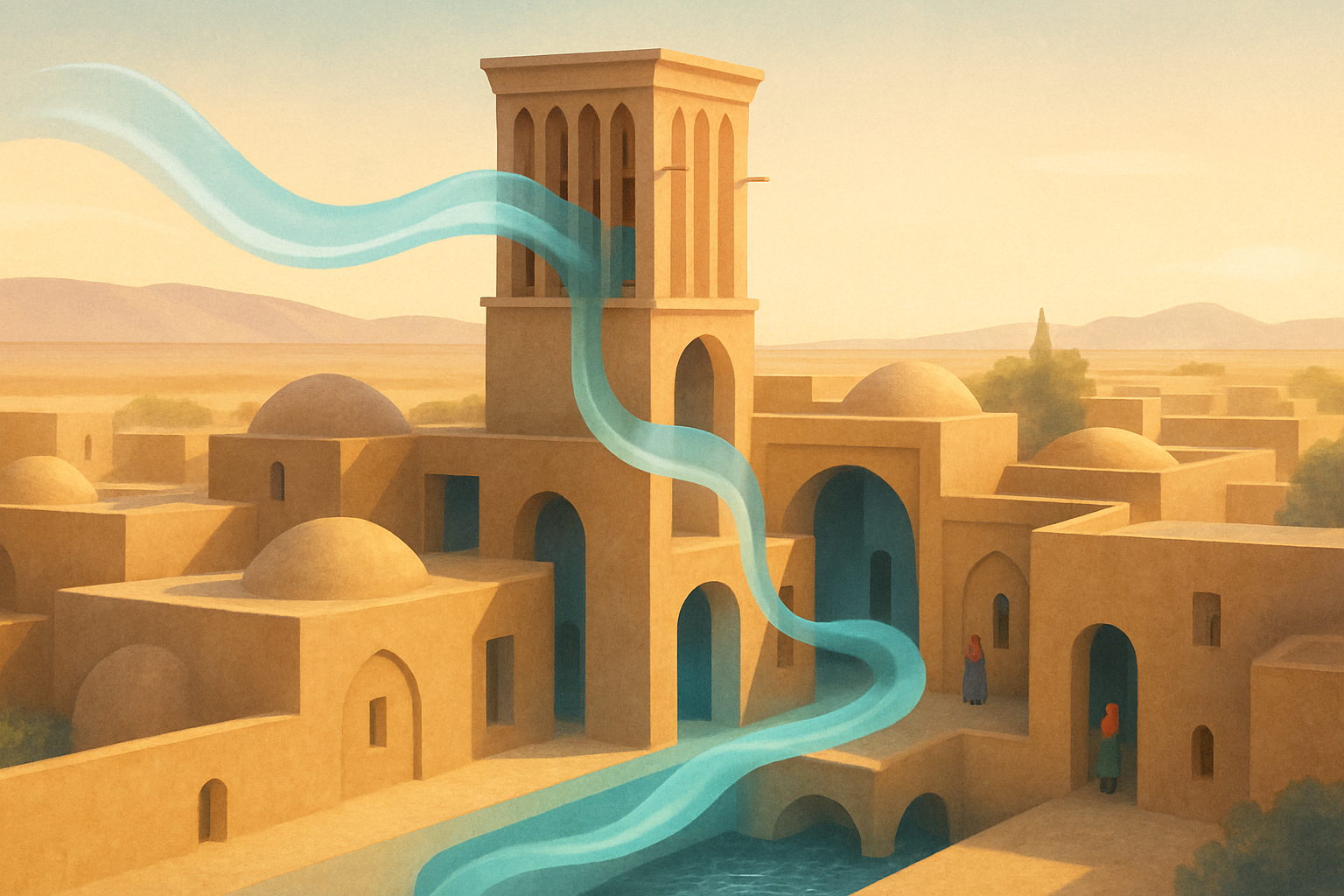
The towers dominating the Yazd skyline are windcatchers — badgirs in Persian — and they’re the single most distinctive structural feature of the city. They work by capturing prevailing winds at height, where air moves faster and cooler than at ground level, channeling it down into the building interior, and in some configurations passing it over a qanat — a small underground water channel — before it circulates through living spaces. Passive air conditioning, centuries before electricity, and in the larger historic houses it actually works. Walking into a room cooled by a badgir and a qanat in July is a noticeably different experience from standing in the sun outside; the mechanism isn’t decorative.
The Dowlat Abad Garden has the tallest surviving badgir in Iran, somewhere around 33 meters, and it’s worth visiting specifically to stand underneath it and feel the airflow rather than just photograph the exterior. The garden itself is pleasant, but the windcatcher is the point.
The Zoroastrian Sites Are Not Optional
Yazd has one of the largest remaining Zoroastrian communities in the world, and the city’s relationship with that heritage is the other thing that makes it unusual. The Towers of Silence (dakhma) sit on two hills about five kilometers outside the city center. These were sky burial sites — the dead were placed at the top so that vultures, rather than fire or earth (both considered sacred), would carry out the decomposition. The practice ended in the mid-20th century, but the towers are intact and you can walk up to them. The view over the desert from the top is genuinely arresting. Nobody will stop you from climbing into the towers themselves, though the interiors are bare; the significance is in the structure and the setting.
The Atash Behram — the Fire Temple — holds a flame that Zoroastrians trace back roughly 1,500 years, kept burning through various relocations including the move to its current building in the 1930s. The claim of continuous burning across that span is meaningful symbolically regardless of how literally you take the chain of custody. Non-Zoroastrians can enter the outer areas and see the flame through a glass partition. It’s a short visit, but the context you bring to it determines what you get out of it.
The Old City on Foot: What to Prioritize
The historic core is small enough to walk in half a day, but the specific half-day matters. Before 9am, the light on the mud-brick walls is different and the narrow alleys are genuinely quiet. The Jameh Mosque of Yazd has the tallest minarets of any mosque in Iran and a tiled facade that photographs well at any hour, but the interior courtyard earns the entrance fee on its own terms.
The Fahadan neighborhood is the oldest surviving residential quarter and worth wandering without a fixed destination. The streets are sometimes barely wide enough for two people to pass, which was deliberate: narrow alleys reduce sun exposure on the walls and on anyone moving through them, and the height of the surrounding walls relative to alley width creates shade for most of the day. Climate-adapted urban planning, not picturesque accident.
Khan-e Lari and Khan-e Tabatabayi are two historic houses open to visitors that show the interior courtyard-and-badgir system at its most developed. Khan-e Lari has a basement reception room connected to the qanat system that makes clear how the cooling actually functioned in practice — it’s the one interior that explains the whole logic of the architecture rather than just displaying it. Entrance fees are minimal and the houses are rarely crowded.
Getting There and When to Go
The overnight train from Isfahan takes roughly four to five hours and arrives early morning — a reasonable way to move between the two cities without losing a day. From Shiraz the timing is similar. Domestic flights from Tehran exist and cut travel time significantly if you’re working against a tight schedule, though the train is more pleasant.
The desert climate is the real planning constraint. April and October are the clear windows: warm enough to be comfortable outside, cool enough that the Towers of Silence don’t require dawn-only visits to be bearable. Summer is survivable but the afternoon heat in July and August is serious — the same badgir-and-qanat physics that cooled historic interiors do nothing for you on an exposed hilltop at 2pm. Winter is cold, especially at night, and accommodation heating is uneven.
Two full days is the minimum that makes the journey worthwhile given the travel time on either end. Three days is comfortable and opens up a half-day trip to the Chak Chak fire temple in the mountains about 70 kilometers north — it carries real significance for the Zoroastrian community and sits in a dramatically different landscape from the city. Most visitors don’t make it there, which is exactly why it’s worth building in if your schedule has room.
One Honest Caveat
Getting to Iran requires more advance planning than most destinations. Visas on arrival are available to some nationalities at certain entry points but not universally, and the international banking situation means carrying sufficient cash — typically euros or US dollars to exchange locally — is not optional. Check current entry requirements through your own government’s travel advisory rather than anything written more than six months ago; the situation has shifted periodically and a blog post is the wrong place to rely on for current visa status.
None of that changes what Yazd is. It’s one of the most coherent surviving examples of pre-modern desert urbanism anywhere, and most people who visit leave thinking they should have given it more time.
Before you lock in the legs on either side of it, ask yourself whether two nights is actually enough — or whether you’re just defaulting to the shortest version because the itinerary already feels full.