
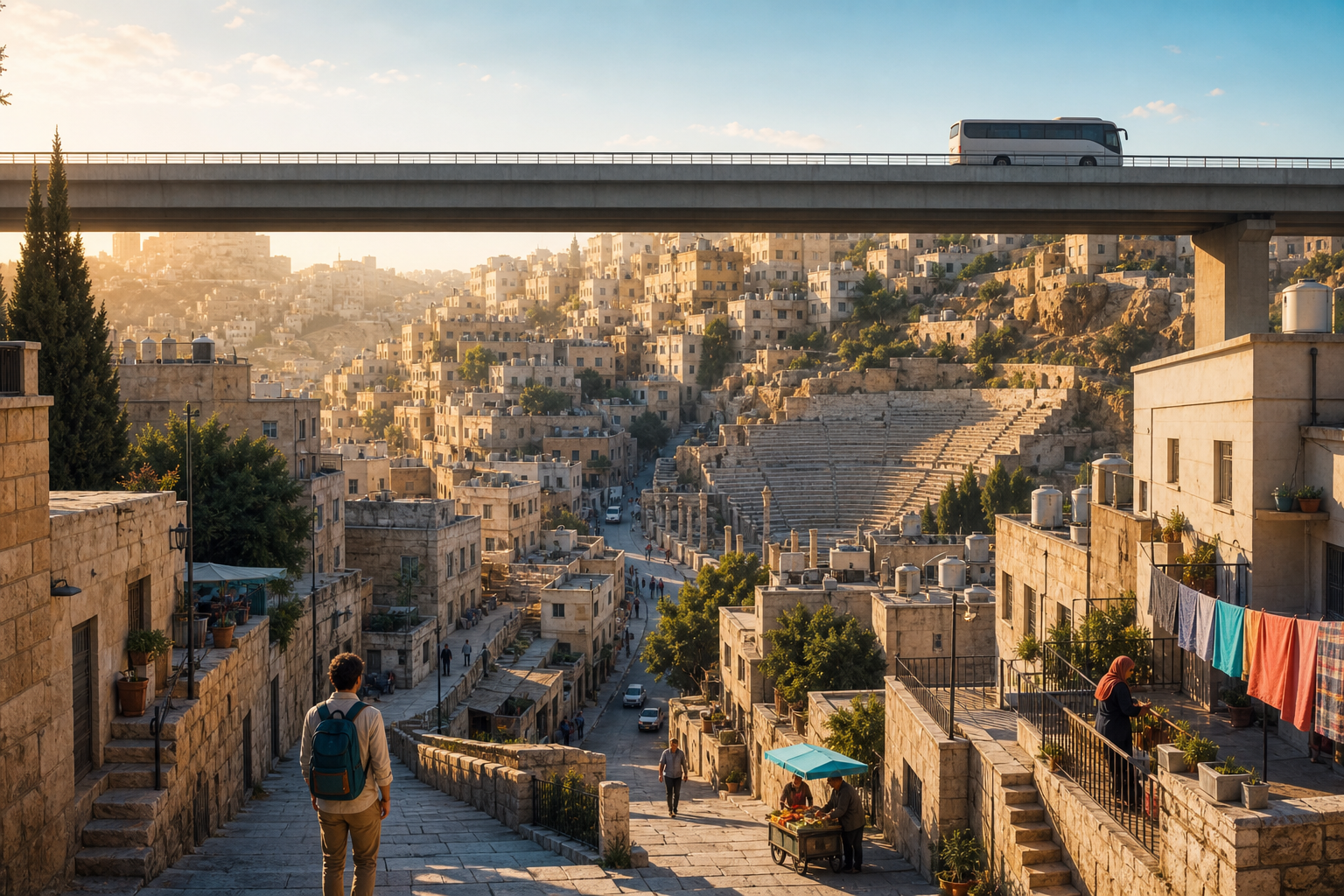
Almost every Jordan itinerary treats Amman the same way: fly in, sleep, leave for Petra the next morning. The city becomes a place to shake off jet lag, not a destination. That’s a genuine mistake, and it compounds — most people who skip it then try to rush back through on the way out and still miss everything that makes it interesting.
View larger map | Map data © OpenStreetMap contributors
Amman is not photogenic in the obvious sense. No single monument photographs well, no medina with a thousand angles, nothing that puts it on a listicle of beautiful Middle Eastern cities. What it has is a very specific urban texture — layered across seventeen hills, mixing Ottoman-era stone buildings with brutalist government architecture and new-money development — and a food culture that is genuinely among the best in the region without being performed for tourists.
How Much Time to Give It
Two full days is enough to stop feeling like you’re checking boxes. One day is not. The city is spread across multiple hilltops connected by steep stairs and no obvious walking logic, so half your first day will disappear to orientation. Embrace that — the disorientation is part of how you understand the place.
The geography divides roughly into East Amman (older, denser, less internationally polished, most of the history and working-class food culture) and West Amman (wealthier neighborhoods like Abdoun and Sweifieh, the expat restaurant scene). Visitors almost exclusively get routed into a block or two near Rainbow Street in the Jabal Amman area, which is fine but nowhere near the full picture.
Start in the Downtown, Not Rainbow Street
The old downtown — Al-Balad — is where Amman actually started. The Roman Theatre sits right in the middle of it: a full second-century amphitheater, capacity around 6,000, still used occasionally for concerts, dropped into a working neighborhood as though this is a completely normal thing to have. Around it there are spice shops, falafel counters open by 7am, and fabric merchants who have been on the same blocks for decades.
Hashem Restaurant, a streetside institution near the downtown, is the one specific food recommendation that belongs in any realistic Amman guide. It’s unglamorous, cash-only, open overnight, and serves foul (slow-cooked fava beans) and falafel at a price that seems implausible for how good it is. It’s been there for over sixty years. The Jordanian royal family has eaten there, which is either meaningful or not depending on your politics, but the food doesn’t need the endorsement.
The Citadel Is Worth Going Early
Jabal al-Qal’a — the citadel hill — has Roman, Byzantine, and Umayyad ruins stacked on top of each other in a way that makes Amman’s full timescale legible in a single visit. The Umayyad Palace complex at the top is partially reconstructed, which some visitors find jarring (the reconstruction doesn’t hide itself), but the view over East Amman from up there is the best orientation point in the city.
Go as early as it opens. By midday in summer the hilltop is fully exposed and genuinely unpleasant, and tour groups have arrived. Spring and autumn are more forgiving, but early morning is still meaningfully different from midday regardless of season.
The Jordan Museum, downhill from the citadel and considerably newer, houses the Dead Sea Scrolls fragments that remain in Jordanian custody — that alone justifies an hour. It’s a real museum with real scholarship behind it, not a souvenirs-plus-history format.
Jabal al-Weibdeh: Where to Slow Down
This neighborhood sits adjacent to Jabal Amman but gets far less foot traffic. It has a slightly bohemian character — small galleries, independent coffee shops, buildings from the 1940s and 50s that haven’t been renovated into boutique hotels yet. The Darat al-Funun arts center is here, inside a cluster of old stone houses with a garden, showing contemporary Arab art. It’s free to enter and consistently worth an hour.
This is the part of Amman where walking without a destination actually makes sense. The streets are quieter, the architecture is unpretentious, and there’s less pressure to be anywhere. One honest caveat: opening hours for galleries and small cultural spaces in this area are inconsistently maintained — worth checking directly rather than trusting aggregator sites, which are often months out of date.
Day Trip Logic: Dead Sea vs. Petra vs. Both
Most visitors use Amman as the base for both the Dead Sea and Petra. These are not the same kind of day trip.
The Dead Sea is about an hour’s drive from Amman. You can do it as a half-day and be back for dinner. The buoyancy is real and immediately disorienting, the salt is genuinely painful in any open cut, and the commercial beaches charge entry fees that are worth it for the shower facilities alone. The free public access point on the northern shore is a rougher experience. Worth knowing before you go.
Petra is a different calculation entirely. It’s three hours from Amman by car, roughly four by JETT bus (reliable, air-conditioned, worth knowing about). A day trip to Petra is technically possible but actively bad — the site takes four to six hours to walk properly, and doing that on top of three hours each way means you’re seeing the Treasury in a sprint and calling it done. Petra deserves an overnight in Wadi Musa. If your itinerary doesn’t have room for that, something else is getting squeezed that probably shouldn’t be.
Getting Around Amman
Taxis are cheap by most international standards and the most realistic way to move between jebels unless you want a real cardio workout on steep stairways. Uber and Careem both operate here reliably, which removes the fare-negotiation friction entirely. Walking works well within individual neighborhoods but poorly between them — the hills mean a 900-meter straight-line distance can easily turn into a 25-minute walk with real elevation gain.
Car rental makes sense only if you’re driving directly to Petra or Wadi Rum. Driving in Amman itself isn’t especially difficult by regional standards, but parking eats time and the taxi infrastructure makes it unnecessary.
When to Go
Spring (March–May) is the clear best window — mild temperatures, no rain, afternoon sightseeing that doesn’t punish you. October and November are nearly as good. Summer is hot, though Amman’s elevation (around 780 meters above sea level in the city center) keeps it more bearable than the Gulf — just not comfortable for midday walking. Winter is cold and occasionally rainy; it’s not closed-season, but it’s not the charming low-crowds situation people hope for either.
Ramadan shifts the city’s rhythm significantly — some restaurants close during daylight hours, others run on delayed schedules, evenings become more active. Whether that’s a reason to go or avoid it depends entirely on whether you want to observe that rhythm or sidestep it.
Put at least two nights in Amman at the start of a Jordan trip, before the Petra leg — not as orientation, but as the actual first destination. The city earns the time if you point yourself at the right parts of it, and those parts are almost never the ones in the first day’s suggested itinerary.