
Dili, East Timor: The Capital That Actually Rewards the Journey
View larger map | Map data © OpenStreetMap contributors
East Timor — officially Timor-Leste — is one of the youngest countries in the world, having gained full independence in 2002 after a brutal Indonesian occupation and a UN-administered transition. Dili is its capital, sitting on a narrow coastal strip backed by steep green hills on one of the least-visited islands in Southeast Asia. Most travelers who make it this far are aid workers, diving obsessives, or people deliberately collecting the corners of the map. That self-selecting crowd is part of why the city is surprisingly easy to navigate once you’re in it.
Getting here takes actual planning. There’s no budget airline hub feeding Dili the way Kuala Lumpur feeds everywhere else in the region. Main connections run through Darwin (roughly 90 minutes on Air Timor) and through Bali and Singapore, with limited frequency. Fares are higher than the distance would suggest — that’s the reality of a low-volume airport. Book well ahead if your dates are fixed, because the few weekly services fill up.
What Dili Is Actually Doing Well
The Cristo Rei statue on the eastern headland is the obvious landmark — a 27-metre Christ figure on a globe, reached by climbing 500 steps from the coast. Do it early: by mid-morning the heat on that exposed hillside is serious, and the views over the Wetar Strait are much clearer before coastal haze builds. Combine it with a swim at the small beach below, where the water around the headland is calm and clear with coral visible from the surface.
The Resistance Museum (Museu da Resistência) is one of the better small museums in Southeast Asia — and having spent time in a lot of poorly executed national museums that treat their subject too reverentially to be informative, this one stands out for not doing that. It covers the Indonesian occupation from 1975 to 1999 with enough primary material — documents, photographs, survivor testimony — that you come out actually understanding something rather than just having looked at things. Plan two hours, not one.
The Mercado Lama near the waterfront is where Dili’s texture concentrates: fresh fish from the Banda Sea, imported produce arriving in the same chaotic trucks as Chinese manufactured goods, women selling betel nut from baskets, the smell of grilled corn. It’s a working market, not a curated one, and the distinction matters. Go before 8am if you want to see it at full speed.
The Dive Situation (Because You Should Know About It)
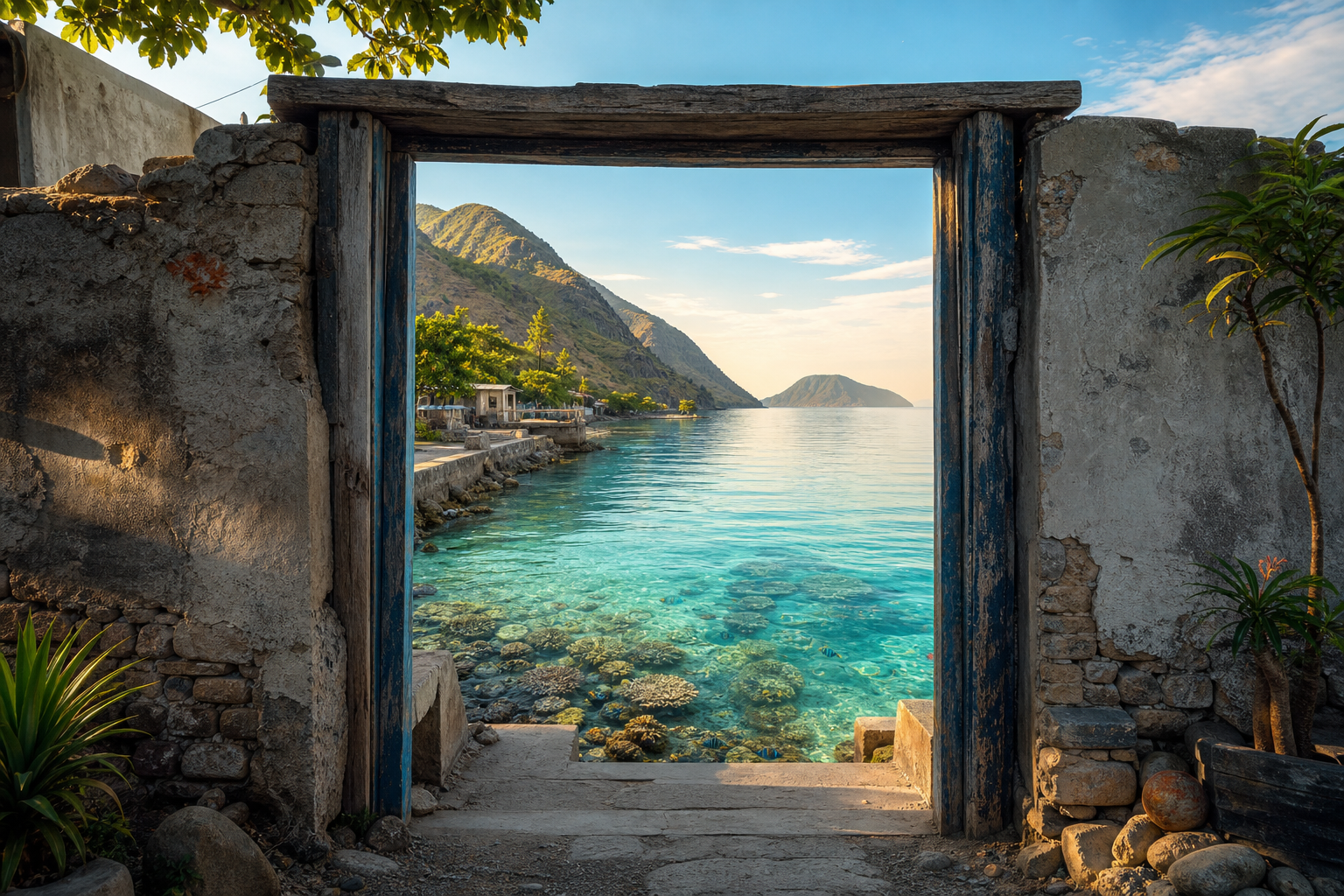
Timor-Leste has some of the best and least-degraded coral reefs in the Coral Triangle — the stretch of ocean running roughly from the Philippines to the Solomon Islands that contains the highest marine biodiversity on the planet. The reefs around Dili’s coastline, and especially the sites around Atauro Island 25 kilometres offshore, are in genuinely remarkable condition by regional standards. A 2016 Conservation International survey ranked Atauro as having among the highest fish density counts ever recorded on a coral reef — that’s a specific, checkable finding, not a dive-shop marketing line.
You don’t need to be an advanced diver. The wall dives off Atauro start in shallow water and visibility typically runs 20 to 30 metres on a normal day. There are a handful of small eco-lodges on Atauro now, some run in partnership with local fishing communities, and two nights there is a much better use of time than treating it as a day trip from Dili. The boat crossing takes about two hours and runs most days during the dry season, May through November.
Day Trips Worth Taking and One That Isn’t
Maubisse, about 70 kilometres south of Dili in the central highlands, sits at 1,400 metres and is a completely different physical and cultural experience from the coast. The Portuguese-era pousada there is one of the more interesting places to sleep in the country — a colonial building on a ridge with views into misty valleys of terraced rice fields. The drive takes two to three hours on a road that gets rough in sections; a 4WD isn’t strictly required, but the peace of mind is worth it after rain.
Baucau, the second-largest city, comes up often as a day trip from Dili. Honest read: it’s three hours each way on a reasonably good coastal road for what amounts to a smaller, quieter version of Dili with a Portuguese-era market hall and an old town that takes an hour to walk. Worth it if you’re spending a full week and want a change of scene. Not worth the round trip as a single day.
Practical Details That Actually Matter
US dollars are the official currency — Timor-Leste adopted them in 2000 during the UN transition and never changed back. ATMs exist in Dili but reliability varies; bring USD cash as backup. The notes in circulation are actual American bills, a detail that doesn’t stop feeling slightly surreal no matter how many times you pull one out.
The food in Dili is Portuguese-Timorese-Indonesian, which is an underappreciated combination. Tukir — grilled fish with chili and lime — shows up everywhere and is almost always good. The Portuguese influence means you can find decent espresso and pastel de nata near the waterfront, which is not something you expect at this latitude. Skip the hotel restaurant default: the local warung spots in the residential neighbourhoods just west of the city center charge a fraction of the price for food that’s at least as good.
Visas on arrival are available for most nationalities at Presidente Nicolau Lobato International Airport. The process tends to be fast — this is not an airport processing large volumes of visitors. Check current requirements with your country’s foreign ministry before you go; policies in small developing nations can shift without much international notice.
One Real Caveat
Timor-Leste’s tourist infrastructure is thin by any standard calibrated to mainland Southeast Asia. Power outages in Dili are not unusual. Internet in accommodation outside the capital can be unreliable or absent. The road network beyond the main coastal route is genuinely difficult in places. None of these are dealbreakers, but travelers arriving with expectations set by Vietnam or Indonesia will find the gaps jarring. The ones who enjoy Dili most tend to be the ones who’ve already made peace with improvisation as part of the deal.
If you’re routing through Darwin or building a trip around the eastern Indonesian islands, Dili is a logical and rewarding addition. If you’re flying from Europe specifically to come here, it’s a harder sell unless the diving is the point — in which case Atauro alone is reason enough to make the trip.
Book accommodation on Atauro before you book anything else. There are only a handful of places to stay, they’re small, and they fill in dry season. Everything else can be figured out once you’re in Dili.