
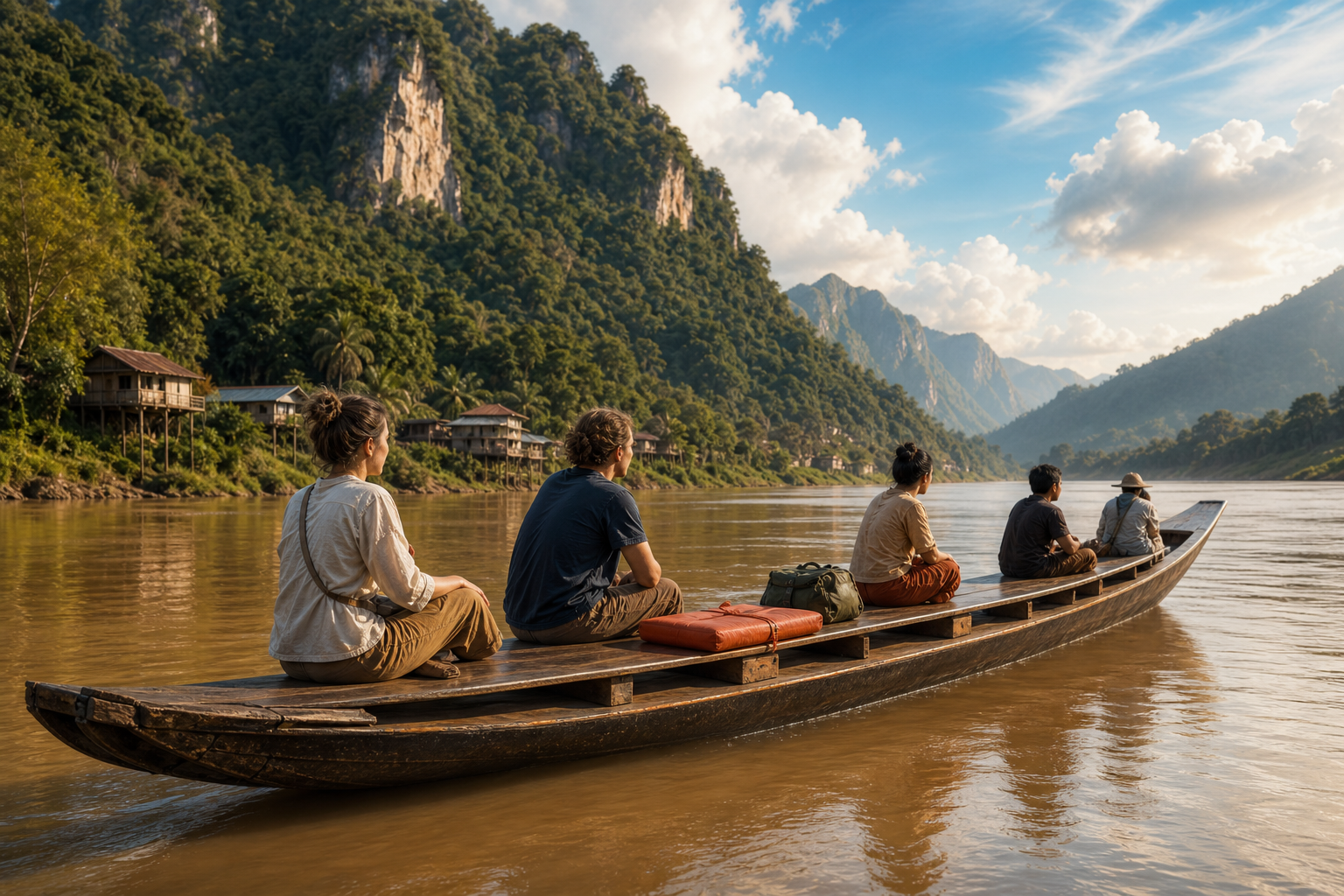
The two-day slow boat down the Mekong from Chiang Khong to Luang Prabang gets described in travel writing as meditative, life-changing, a rite of passage. Some of that is true. A fair amount of it is retroactive romanticization from people who’ve forgotten how long two days on a wooden bench actually feels. The reality sits somewhere between genuinely beautiful and genuinely grueling — and which side dominates depends almost entirely on what you’ve set yourself up to expect and whether you’ve done a few things before you board.
View larger map | Map data © OpenStreetMap contributors
Getting to Chiang Khong
Chiang Khong is a small Thai border town about 300 kilometers northeast of Chiang Mai. No direct train. You get there by bus from Chiang Rai (roughly 2.5 hours) or as part of a longer bus run from Chiang Mai that typically takes 6–7 hours and drops you the night before your crossing. Most people doing this route build in a night in Chiang Rai first, which is worth doing on its own — the White Temple (Wat Rong Khun) is genuinely strange and worth an hour, and the night market near the clock tower is one of the more manageable ones in northern Thailand.
The actual border crossing from Chiang Khong into Huay Xai involves a ferry across the Mekong, a visa-on-arrival process on the Lao side (around $30–35 USD depending on nationality, cash only, bring passport photos), and then finding your boat ticket. Buy the ticket in Huay Xai itself, not from any tout on the Thai side who tells you they can save you time. They cannot.
Day One on the River
The boats leave around 11am and you want to be on the Lao side no later than 9:30 to buy tickets and claim a seat. The slow boats are long wooden passenger vessels, rebuilt repeatedly over the years, with bench seating that has improved on some boats and stayed genuinely punishing on others. There’s no assigned seating. Arriving early is the difference between a cushioned bench near a window and a hard plank in the middle of a dark cabin.
Day one runs roughly six hours to Pakbeng, the overnight stop. The scenery — and this part of the romanticization holds up — is legitimately beautiful. Dense jungle hills, limestone outcrops, the occasional village on stilts, fishermen in narrow wooden longboats. The Mekong through this section runs wide and brown and powerful, and watching it slide past for hours does eventually produce a kind of calm that’s hard to manufacture any other way. The problem is the bench. Six hours is long enough that it becomes its own preoccupation.
Pakbeng is a single-street town that exists almost entirely to house slow boat passengers for one night. The guesthouses are basic. The food is fine. There’s one reasonable bar. Go to sleep early — the boat leaves again at 9am.
Day Two and Arrival at Luang Prabang
Day two is the longer stretch, typically eight to nine hours depending on river level and how often the boat stops. The scenery stays good, and by day two you’ve made a kind of peace with the pace — or you’ve spent the afternoon counting kilometers. Arrival in Luang Prabang is usually somewhere between 5pm and 6pm, but don’t hold that tightly. River conditions, fuel stops, passengers on and off at intermediate villages — any of these can shift the arrival by an hour or more in either direction.
One genuinely useful thing: bring more food than you think you need. The boat typically has a vendor selling chips, instant noodles from a kettle, and beer. That’s the full menu. Stock up in Huay Xai at the market before you board.
The Alternative Nobody Wants to Hear About
The speedboat exists. It covers the same route in around six hours instead of two days. It is also extremely loud, requires a crash helmet, and involves sitting in a narrow fiberglass tube that bounces off the river surface at high speed. Fatalities have happened on this route — not frequently, but they happen. The slow boat is not the dangerous option here.
The other alternative is flying — Chiang Rai or Chiang Mai to Luang Prabang direct, under two hours. If your time is genuinely constrained or your back isn’t up for two days of bench, fly. There’s no moral weight attached to taking the slow boat. It’s an experience, not an obligation.
Whether It’s Worth It
My read: yes, once, if you have the days. The slow boat forces a pace that almost nothing else does in this part of Southeast Asia. You can’t shortcut it or optimize it. You just sit there while the river does what rivers do. For people who travel fast by habit, it’s either unbearable or exactly what they needed — and it’s genuinely hard to know which until you’re in it.
Be clear with yourself about what you’re not getting: this is not a luxury river cruise. There are no cabins. The toilet is a small room at the back of the boat. WiFi doesn’t exist. Go in expecting the cinematic Amazon-explorer version of Southeast Asian river travel and you’ll be disappointed. Go in expecting two long days on the Mekong with spectacular scenery and no agenda, and you’ll probably get exactly that.
Practical Specifics Before You Go
The route runs year-round, but low-water season (roughly February through April) can cause delays or force alternative landing points — the boats draft shallower than they look, but sandbars still cause problems. November through January is the most reliable window, with cooler temperatures on the river and higher water levels. High season means a full boat; getting to the dock early matters more in December than in June.
Laos e-visa now works for most nationalities and can be processed before you leave home, which removes one variable from the Huay Xai crossing. Do it. The visa-on-arrival queue on a busy day at that border moves slowly, and slow is the one thing you don’t need more of on a morning when you’re also trying to catch a 9am boat.
One caveat worth stating plainly: Luang Prabang is managing an overtourism problem that has gotten worse each post-pandemic year. Walking off the boat into a town packed with tour groups strips some of the romance off the arrival. It’s still worth going — but book accommodation well in advance in peak season, and treat your first morning as a reset. The 5:30am alms-giving ceremony is worth waking up for if you can observe it quietly rather than photographing from two feet away.
Before you book, one question worth sitting with: are you doing the slow boat because you actually want two days on the Mekong, or because it seems like the thing you’re supposed to do on this route? Both reasons get you onto the same boat. Only one of them tends to produce the trip people are still talking about a year later.